
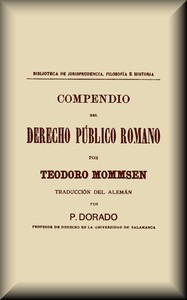
Compendio del derecho público romano by Theodor Mommsen
Let's be clear: this is not a beach read with a thrilling plot twist on page 200. The 'story' here is the 1,200-year-long project of building and running the Roman state. Mommsen organizes this massive undertaking into a clear structure. He starts with the fundamental sources of Roman law and the people it governed—citizens, non-citizens, and everyone in between. Then, he walks us through the engine room: the magistrates (from consuls to tax collectors), the Senate (the ultimate advisory board), and the various public assemblies where citizens could vote. Finally, he examines how this whole system administered conquered territories and managed its finances. The narrative is the slow, relentless evolution of public institutions, from the early Republic to the Imperial era.
Why You Should Read It
You should read it because Mommsen makes ancient bureaucracy fascinating. He has a historian's eye for the telling detail and a storyteller's knack for showing how things actually worked. You don't just learn that the Senate had power; you see how its influence seeped into every decision. You understand why the office of Tribune of the Plebs was a political grenade. This book strips away the marble statues and epic battles to show the cogs and levers—the laws, procedures, and political norms—that allowed Rome to function. It answers practical questions like: How did you become a governor? What could a citizen actually do if he felt wronged by the state? In doing so, it reveals the Romans as brilliant, pragmatic system-builders whose solutions to problems of power and governance still shape our world.
Final Verdict
This book is a must for anyone with a serious interest in history, political science, or law. It's perfect for the reader who enjoyed the broad sweep of a book like SPQR by Mary Beard and now wants to understand the precise mechanics behind the story. It's also incredibly rewarding for writers, world-builders, or anyone curious about how societies organize themselves. Be warned: it's a dense, scholarly work. It asks for your attention, but if you give it, you'll be rewarded with a masterclass in how one of history's most influential civilizations was actually run. Think of it as the ultimate technical manual for the Roman Empire, written by its greatest engineer.
This digital edition is based on a public domain text. It is available for public use and education.
Richard Smith
1 year agoThe digital formatting makes it very easy to navigate.
Jennifer Thompson
11 months agoI particularly value the technical accuracy maintained throughout.
George Johnson
11 months agoExceptional clarity on a very complex subject.
Michael Jackson
1 month agoI decided to give this a try based on a colleague's recommendation, the data points used to support the main thesis are quite robust. A rare gem in a sea of mediocre content.







Patricia Lopez
1 year agoThis was exactly the kind of deep dive I was searching for, the nuanced approach to the central theme was better than I expected. Highly recommended for those seeking credible information.