
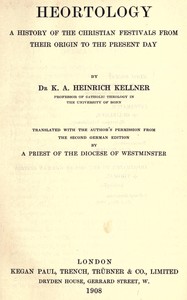
Heortology : A history of the Christian festivals from their origin to the…
Let's be honest: most books with 'ology' in the title can be a bit of a slog. Not this one. Heortology is a journey into the DNA of our calendar. Karl Heinrich Kellner, writing over a century ago, acts as your guide through the tangled roots of Christian celebrations like Christmas, Easter, and Pentecost.
The Story
Kellner doesn't just list dates and decrees. He starts with a simple, powerful question: 'Why do we do this?' From there, he walks you through the early centuries after Jesus. You see how the first believers, who were mostly Jewish, began to mark time differently. Then, as the faith spread across the Roman Empire, things got interesting. Kellner shows how local spring festivals were woven into Easter, how midwinter solstice celebrations shaped Christmas, and how saints' days often grew from older hero cults. The 'plot' is the slow, messy, and utterly human process of how a faith without official holidays built a yearly cycle of feasts that would define Western culture.
Why You Should Read It
What makes this old book so compelling is its perspective. Reading Kellner is like getting a time-traveler's postcard. You see our modern traditions through the eyes of a 19th-century scholar looking back at ancient sources. It makes you realize how layered and accidental history is. The chapter on how the date of Christmas was argued over for centuries is both hilarious and illuminating. You come away understanding that holidays aren't born in a vacuum; they're negotiations between faith, culture, weather, and politics. It gives you a new appreciation for the stories baked into our year.
Final Verdict
This book is perfect for curious minds who love 'aha!' moments. It's for the person who decorates a Christmas tree but wonders about its origins, or who eats Easter eggs while pondering their connection to ancient symbols. It's not a light read—Kellner packs in a lot of detail—but it's written with a clear passion for the subject. If you enjoy connecting the dots between history, religion, and everyday life, you'll find this a treasure trove. Just be prepared to have your next holiday gathering interrupted by you saying, 'Hey, did you know...?'
You are viewing a work that belongs to the global public domain. Enjoy reading and sharing without restrictions.
Susan Davis
2 years agoBeautifully written.
Robert Robinson
1 year agoRecommended.
Ashley Brown
10 months agoComprehensive and well-researched.
Sarah King
1 year agoThanks for the recommendation.






Jessica Miller
1 year agoI've been looking for a reliable source on this topic, and the argument presented in the middle section is particularly compelling. Simple, effective, and authoritative – what else could you ask for?