1

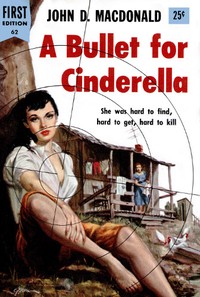
A Bullet for Cinderella — A Reader’s Guide
(0 User reviews)
392
Project Gutenberg
2015
Not confirmed
Detective and mystery stories; American fiction -- 20th century
Readers of public-domain and historical texts
Project Gutenberg digital edition
en
Edition facts
Words
59,804
Reading time
261 min
Text sections
5
Before opening A Bullet for Cinderella — A Reader’s Guide, the edition data offers a quick orientation: 59,804 words, 4 hr 21 min estimated reading time, and 5 detected text sections.
The text analysis averages about 9.2 words per sentence, while the detected sections provide another way to judge how the source is divided.
Project Gutenberg metadata also associates the work with “Detective and mystery stories,” connecting these edition facts with the source record’s subject description.
Source:
Project Gutenberg record #49931
John D. MacDonald's 1955 crime novel follows ex-POW Tal Howard as he returns to a small town searching for hidden money, guided only by a dying friend's cryptic clue. The narrative shifts between hard-boiled investigation and uneasy reunions, with sharp dialogue and a restless first-person voice.
Editorial Edition Score
4.7/5
★★★★★
★★★★★
Calculated from edition completeness, EPUB availability, text structure and catalogue metadata. Not a user rating.
How this score is calculated
- Description quality20 pts
- Title & short description10 pts
- Source metadata20 pts
- Text length15 pts
- Chapters / structure15 pts
- EPUB file integrity20 pts
Total of 100 points, scaled to a 2.5-5.0 range. Editions with an empty description or a missing EPUB file are not scored.
Edition quality
Read the Text
They were quiet for a while until suddenly he heard her breath begin to quicken. She turned toward him and he pulled her close. There was time....
A steady April rain was soaking the earth. It hadn't been bad to drive through until dusk came. In the half-light it was hard to see the road. The rain was heavy enough to reflect my headlights back against the wind-shield. My mileage on the speedometer told me I couldn't be very far from Hillston.
When I saw the motel sign ahead on the right I slowed down. It looked fairly new. I turned in. The parking area was paved with those round brown pebbles that crunch under the tires. I parked as close to the office as I could get and ran from the car into the office. A woman with the bright cold eyes and thin sharp movements of a water bird rented me a room far back from the highway sound. She said the place was just four miles from the Hillston city limits.
Once I saw the room I decided that it would do. It would be a good place to stay while I did what had to be done in Hillston. I stretched out on the bed and wondered if I had been smart to use my right name on the motel register. But if I could find the money, there would be no one to say that I was the one who had taken it. And using my right name wouldn't make any difference at all.
When at last the rain eased up I went and found a small roadside restaurant. The girl behind the counter told me where I could buy a bottle of liquor. She seemed open to any invitation to help me drink it up, but though she was reasonably pretty I was not interested. I had this other thing on my mind and I wanted to go back alone and have some drinks and think about it and wonder how I could do it.
Maybe you saw pictures of us, the ones who were really bad off when the prisoners were exchanged. I was one of the litter cases. My stomach had stopped digesting the slop they fed us, and I was down to ninety-three pounds. One more week and I would have been buried up there beyond the river like so many others were. I was in bad shape. Not only physically but mentally. I was too sick to be flown back. Memory was all shot. I went right into hospital and they started feeding me through a tube.
It was during the months in the military hospital back in this country that I began to sort things out and began to remember more of the details about Timmy Warden of Hillston. When the intelligence people had interrogated me I had told them how Timmy died but nothing more than that. I didn't tell them any of the stuff Timmy had told me.
We were both captured at the same time in that action near the reservoir. I'd known him casually. He was in a different platoon. We were together most of the time after we were captured. Enough has already been written about how it was. It wasn't good.
That prison camp experience can change your attitude toward life and toward yourself. It did that to Timmy Warden. His one thought was to survive. It was that way with all of us, but Timmy seemed more of a fanatic than anybody else. He had to get back.
He told me about it one night. That was after he'd gotten pretty weak. I was still in fair shape. He told me about it in the dark, whispering to me. I couldn't see his face.
"Tal, I've got to get back and straighten something out. I've got to. Every time I think about it I'm ashamed. I thought I was being smart. I thought I was getting what I wanted. Maybe I've grown up now. I've got to get it straightened out."
"What was it you wanted?"
"I wanted it and I got it, but I can't use it now. I wanted her too, and had her, but she's no good to me now."
"I'm not following this so good, Timmy."
He told me the story then. He had been in business with his brother George Warden. George was older by six years. George took him in as a partner. George had a flair for salesmanship and promotion. Timmy was good on the books, as he had a natural knack for figure work. They had a building supply business, a retail hardware outlet, a lumberyard, and several concrete trucks.
And George had a lush, petulant, amoral, discontented young wife named Eloise.
The novel opens with a steady April rain and a motel parking lot paved with round brown pebbles that crunch under the tires. The first-person narrator, Tal Howard, is immediately established as a man on a specific errand, one that requires him to think alone with a bottle of liquor. The voice is clipped, observant, and slightly world-weary, a tone that carries through the early pages as he weighs the risks of using his real name on the motel register. The prose wastes no time on atmosphere for its own sake; every detail—the rain, the pebbles, the woman with bright cold eyes—serves to anchor the reader in a concrete, slightly gritty world where the narrator's past is a shadow he cannot shake.
A Voice Between Lives
The first-person narration in A Bullet for Cinderella is notable for its controlled, almost clinical detachment. Tal Howard describes himself as being "between lives," and the prose reflects that suspension: he observes the world around him with a kind of flat precision, noting the crunch of pebbles and the sheen of a woman's eyes without emotional embellishment. This voice is consistent even in moments of potential tension, such as when he confronts Cindy and she accuses him of acting "like a little kid inspecting a leper colony." The dialogue is sharp and unadorned, with characters speaking in short, direct sentences that reveal their guardedness. The narrative pace mirrors Tal's own uncertainty—he is a man waiting for something to happen, and the text moves with a deliberate, almost hesitant rhythm, punctuated by bursts of blunt exchange.
The Weight of the Past
The excerpts reveal a story deeply concerned with the lingering effects of war and imprisonment. Tal's time as a prisoner is referenced obliquely—he mentions "prison camp" and a fellow prisoner named Timmy who died—but the narrative does not dwell on the experience. Instead, it shows the aftermath: Tal is adrift, without a permanent address or a clear purpose beyond finding the hidden money. His search for Cindy is framed as a "sentimental journey" that quickly turns uncomfortable, as the past resurfaces in the form of old classmates and a blind teacher. The dialogue between Tal and Cindy is laced with references to shared history—Timmy, eighth-grade plays, a girl named Cindy Waskowitz—but these memories are treated as fragments, not as a cohesive backstory. The novel seems to use these fragments to build a sense of dislocation, where the past is both a burden and a key to the present.
Pace and the Unfolding Clue
The pacing in the opening chapters is deliberately uneven. The first chapter moves slowly, with Tal checking into a motel, eating at a roadside restaurant, and thinking about his plan. The prose lingers on small details—the pebbles, the rain, the woman behind the counter—before the narrative shifts into a more rapid exchange of dialogue when Tal meets Cindy. This shift in pace mirrors the change in Tal's state of mind: from solitary contemplation to active engagement. The clue that drives the plot—"Cindy would know"—is introduced almost casually, buried in a conversation about Timmy's death. The novel does not rush to explain the significance of the hidden money or the nature of Tal's relationship with Timmy; instead, it lets the information emerge through the rhythms of conversation, with pauses and interruptions that mimic real speech. This technique keeps the reader attuned to the gaps in the story, the things left unsaid.
Readers should pay attention to the way MacDonald uses small, concrete details—the crunch of pebbles, the shape of a woman's teeth—to build a world that feels both immediate and slightly off-kilter. The first-person narration is a lens that distorts as much as it reveals, and the gaps in Tal's story are as important as what he chooses to tell. The novel rewards close attention to the rhythm of its dialogue and the weight of its silences.
Rain slid down the glass that afternoon while A Bullet for Cinderella kept me company, its restless search for hidden money feeling oddly like my own wandering thoughts. When the last page turned, I sat quiet, and the lamp’s glow caught an older spine nearby — The Mysteries of London, v. 4/4 — Story, Setting & Ideas, another city’s secrets, waiting patiently.
There are no reviews for this eBook.
There are no comments for this eBook.
Reader reflection
What was your reading experience?
Capture what you thought, learned, and would like to remember.
Your progress
0
/
10
2
How did the book work for you overall?
3
Would you recommend this book to another reader?
4
What was the reading difficulty like?
5
Could you see yourself revisiting this book?
6
Did it raise ideas you would like to talk about?
7
How strong was your personal connection to the text?
8
How would you rate its originality?
9
Which lesson or insight stayed with you?
10