1

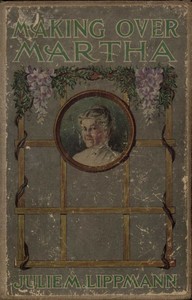
Making Over Martha — Story, Setting & Ideas
(0 User reviews)
665
Project Gutenberg
2016
Not confirmed
Country life -- Fiction; New England -- Social life and customs -- Fiction
Readers of public-domain and historical texts
Project Gutenberg digital edition
en
Edition facts
Words
74,553
Reading time
325 min
Text sections
11
Making Over Martha — Story, Setting & Ideas can be approached with a clearer sense of reading commitment from its source measurements: 74,553 words, 5 hr 25 min estimated reading time, and 11 detected text sections.
The text analysis averages about 12.5 words per sentence, while the detected sections provide another way to judge how the source is divided.
Project Gutenberg metadata also associates the work with “Country life -- Fiction,” connecting these edition facts with the source record’s subject description.
Source:
Project Gutenberg record #52668
Martha Slawson, a resourceful New England woman, orchestrates a homecoming reception with a motto and later outwits a pursuer at a train station, showcasing her quick thinking and domestic authority in rural early 1900s.
Editorial Edition Score
4.7/5
★★★★★
★★★★★
Calculated from edition completeness, EPUB availability, text structure and catalogue metadata. Not a user rating.
How this score is calculated
- Description quality20 pts
- Title & short description10 pts
- Source metadata20 pts
- Text length15 pts
- Chapters / structure15 pts
- EPUB file integrity20 pts
Total of 100 points, scaled to a 2.5-5.0 range. Editions with an empty description or a missing EPUB file are not scored.
Edition quality
Read the Text
nge go out hours ago."
"Never you mind about that. I got some alcohol by me, an’ if you show me the kitchen range, I’ll show you a fire in it, all right, all right."
"I don’t know how it is," sighed Miss Crewe, leading the way through dark passages, past shadowy doors, "but, somehow, a great load seems lifted off my heart, now you’re here. I’ve never seen you before, but I feel you’re able to set everything right."
"You go on feelin’ that way. It’ll help me no end with the _settin’_. An’, now, don’t you wait here. You run on up to the ol’ lady, an’ I’ll be along presently. I’m used to kitchens. I can find all I need in’m, an’ when I got the hot water, I can find my way out."
"I’m afraid you’ll think the floor isn’t very clean," the girl observed regretfully, pausing, with her hand upon the doorknob, to gaze back dubiously. "I suppose it needs a long-handled scrubbing-brush, and——"
By the light of the lamp Miss Crewe left behind her when she went, Martha made a quick survey of the premises. "’A long-handled scrubbing-brush,’" she quoted quizzically. "A long-handled Irish woman, more likely. My, but it’s a caution, if you turn up your nose at work, how the dirt will gather under it. It’s like to take me all night to make a impression on this place. The grate chock-full o’ clinkers, an’ the _kettles_—say, but I didn’t say I’d give the ol’ lady a hot _mud_-bath."
For a few moments the kitchen resounded with thunderous echoes to the vigorous efforts of Mrs. Slawson toward reconstruction. Then followed other sounds, those of crackling wood, igniting coals, bubbling water, escaping steam. In the midst of it all, Sykey appeared in the doorway.
"Oh, Mrs. Slawson," she deplored, before she had fairly crossed the threshold. "I’m afraid it’s no use. Grandmother won’t have it. I told her about your coming and offering to help, and—she won’t have it."
Martha nodded reassuringly. "Well, we won’t worry her talkin’ about it, an’ we won’t worry our-selves _thinkin’_ about it. Have you gotta bath-tub handy?"
"Plenty o’ towels—bath-towels? The fuzzy-wuzzy, warm kind which they call’m Turkish or Russian, I don’t know which, but that gets up a gentle irritation when applied, just like some folks."
"Then, the best thing you can do is, get’m ready. It’ll keep your mind off’n her not bein’ willin’. We want everything laid out handy, so’s we won’t have to go on a still-hunt the last minute. I got plenty o’ water, steamin’ hot. If you’ll go along up, an’ kinda _perpare for the worst_, I’ll folla along presently, an’—we’ll _have_ it."
A single shaded lamp left the great bedroom in partial shadow, but as Martha approached the majestic four-poster, about five minutes later, she made out the figure of a diminutive old woman, stretched full length beneath the spare coverings. There could be nothing formidable in such a tiny figure. It was only when Mrs. Slawson looked down upon the face, that she met a pair of eyes that fairly held her at bay.
"I’m Mrs. Sammy Slawson," she announced, a shade less confidently than usual. "I live down the road a ways—superintendent for Mr. Frank Ronald, me an’ my husband is."
The little body on the bed might be half dead, but the great eyes were fiercely alive. They measured Mrs. Sammy Slawson from head to foot, with a stare of icy insolence.
Martha did not quail. She met the stare with a perfectly unflinching gaze, then went on talking as she worked, as calmly as if she were not being challenged in mortal combat.
The novel opens with Martha Slawson stitching a white cotton banner bearing the motto “HAIL TO THE CHIEF” in yellow letters, intended as a welcome for her employers returning from a year-long wedding tour. Her husband Sam questions the choice, but Martha insists it is inclusive and avoids singling out the bride. This scene immediately establishes Martha’s practical, decisive nature and her role as the orchestrator of domestic ceremonies. The sewing-machine, the billowing cloth, and the careful planning of lanterns and laurel arches ground the story in tangible, hands-on preparation.
Stitching a Welcome: The Motto as a Structural Device
The motto “HAIL TO THE CHIEF” serves as a recurring image that ties together the opening and later events. Martha’s labor over the banner—described as a “snowy drift” of cloth—mirrors her methodical approach to problem-solving. The motto itself is a deliberate choice, reflecting her sensitivity to social dynamics: she avoids “HAIL TO THE BRIDE” to prevent slighting the groom. This attention to symbolic detail recurs when Martha later uses a piece of burlap-covered baggage to conceal a young woman, Ellen, and tosses it onto a moving train. The same ingenuity that produced the motto now enables a daring rescue. The motto thus becomes a touchstone for Martha’s character: she crafts both literal and figurative messages that assert control over her environment.
The Train Station: A Stage for Confrontation
The train station sequence in Chapter X contrasts sharply with the domestic opening. Here, Martha faces Buller, a menacing figure who demands Ellen be handed over. The setting is public, noisy, and fraught with danger. Martha remains calm, even bowing civilly after Buller’s outburst. The scene is structured around precise timing: the baggage-man, the brakeman, and the slow-moving car all play roles in a choreographed escape. Martha’s line, “That’s just what I’m waitin’ to do,” underscores her readiness. The train itself becomes a moving boundary between threat and safety. This episode demonstrates how the novel shifts between intimate home scenes and high-stakes public encounters, with Martha as the steady pivot.
Dialogue as a Marker of Voice and Authority
Martha’s speech is distinctive: colloquial, direct, and laced with humor. She tells Sam, “Men ain’t much on seein’ where sentiment’s concerned,” and later dismisses Buller with “Same to you, sir.” Her husband Sam, by contrast, is quieter and more hesitant, often yielding to her judgment. The dialogue reveals a partnership where Martha takes the lead, especially in crises. When Sam admits he was “too tired to get up” to answer Ellen’s knock, Martha replies pleasantly, “You were smart to hear it through your own snores.” This exchange shows her ability to criticize without rancor, maintaining domestic harmony while asserting her competence. The novel uses such conversational rhythms to build character and advance plot without lengthy exposition.
Movement Between Interior and Exterior Spaces
The narrative moves fluidly between the Slawsons’ home—with its sewing-machine, center-table, and “The New England Farmer”—and external locations like the train platform and Dr. Ballard’s motor-horn arrival. This spatial contrast reinforces Martha’s dual role as homemaker and public actor. The opening chapter is confined to the domestic interior, where Martha’s sewing dominates. Later, the train station expands the stage, and the final excerpt shifts to Madam Crewe’s sitting-room, where Dr. Ballard confronts a personal history. Each setting carries its own rhythm: the steady treadle of the sewing-machine, the thunder of the train, the musical horn. These auditory details anchor the reader in specific moments, making the transitions between scenes feel purposeful rather than arbitrary.
Readers attentive to Martha’s resourcefulness will find that her actions—whether stitching a motto or outwitting a pursuer—spring from the same practical intelligence. The novel rewards close attention to how objects and phrases recur, linking domestic craft with decisive intervention. The excerpts suggest a story where small gestures carry large consequences, and where the line between home and world is constantly crossed.
Martha’s cleverness at that train station stayed with me, that quiet triumph of someone used to managing a household. It reminded me of another story about ordinary resourcefulness meeting the strange, The Changeling — Context and Discussion, where the familiar turns just slightly askew. Both left me thinking about how we hold our ground when everything else shifts. That feeling lingers.
There are no reviews for this eBook.
There are no comments for this eBook.
Reader reflection
Before you leave, reflect on the book
Use these questions to collect your thoughts before moving on.
Your progress
0
/
10
2
How did the book work for you overall?
3
Would you pass this book on to a friend?
4
How demanding did the text feel?
5
Would this book work well in a reading group?
6
Is this a title worth rereading?
7
Did the book deliver what you hoped for?
8
What was its emotional impact?
9
What did this book teach you most?
10