1

The Chronic Loafer — Reading Notes
(0 User reviews)
615
Project Gutenberg
2017
Not confirmed
Pennsylvania -- Fiction; American fiction
Readers of public-domain and historical texts
Project Gutenberg digital edition
en
Edition facts
Words
63,320
Reading time
276 min
Text sections
6
For The Chronic Loafer — Reading Notes, the stored edition analysis reports 63,320 words, 4 hr 36 min estimated reading time, and 6 detected text sections.
The text analysis averages about 15.6 words per sentence, while the detected sections provide another way to judge how the source is divided.
Project Gutenberg metadata also associates the work with “Pennsylvania -- Fiction,” connecting these edition facts with the source record’s subject description.
Source:
Project Gutenberg record #54572
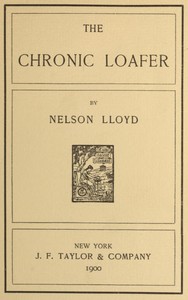
Nelson Lloyd's 1900 novel uses a Pennsylvania village store as a stage for oral storytelling, dialect, and superstitious lore. The excerpts show a frame-tale structure where the Chronic Loafer and other loungers swap ghost stories during a storm, revealing more about local character than plot.
Editorial Edition Score
4.7/5
★★★★★
★★★★★
Calculated from edition completeness, EPUB availability, text structure and catalogue metadata. Not a user rating.
How this score is calculated
- Description quality20 pts
- Title & short description10 pts
- Source metadata20 pts
- Text length15 pts
- Chapters / structure15 pts
- EPUB file integrity20 pts
Total of 100 points, scaled to a 2.5-5.0 range. Editions with an empty description or a missing EPUB file are not scored.
Edition quality
Read the Text
omrade, what air you starin’ so fer?’
“Sais he, ‘That letter was fer Mary Parker?’
“‘True,’ sais I, surprised.
“‘Dead sure?’ sais he.
“Then he shakes his fist an’ yells, ‘I’ve ’tended most every reunion here sence the war hopin’ to meet the idjet that sent that letter to my wife an’ wrote that foolishness ’bout findin’ my dead body. After twenty-five years I’ve foun’ you!’
“He pulls off his coat. The boys all jumps up.
“I, half skeert to death, cries, ‘But you ain’t the dead man!’
“‘Dead,’ he yells. ‘Never ben near it. Nor did I ’tend to hev every blame fool in the army mailin’ my letters nuther. Because you finds a man with my coat on, that hain’t no reason he’s me. I was gittin’ to the rear with orders ez lively ez a cricket an’ th’owed off that coat jest because it was warm runnin’.’
“‘Hen I seen what I’d done I grabs his arm, I was so excited, an’ cries, ‘Did she merry Silas Quincy?’
“‘It wasn’t your fault she didn’t,’ he sais, deliberate like, rollin’ up his sleeves. ‘I got home two days after the letter an’ stopped the weddin’ party on their way to church.’”
The Chronic Loafer stretched his legs along the counter and rested his back comfortably against a pile of calicoes.
“I allus held,” he said, “that they hain’t no sech things ez a roarinborinallus. I know some sais they is ’lectric lights, but ’hen I seen that big un last night I sayd to my Missus, an’ I hol’ I’m right, I sayd that it was nawthin’ but the iron furnaces over the mo’ntain. Fer s’pose, ez the Teacher claims, they was lights at the North Pole--does you uns believe we could see ’em all that distance? Well now!”
He gazed impressively about the store. The Patriarch, the Miller and the G.A.R. Man were disposed to agree with him. The School Teacher was sarcastic.
“Where ignorance is bliss ’twere folly to be wise,” he said. He tilted back on two legs of his chair and adjusted his thumbs in the arm-holes of his waistcoat, so that all eight of his long quivering fingers seemed to be pointing in scorn at the man on the counter.
The Loafer rolled slowly over on one side and eyed the pedagogue.
“Ben readin’ the almanick lately, hain’t ye?” he drawled.
“If you devoted less time to the almanac and more to physical geography,” retorted the Teacher, “you’d know that the Aurora Borealis hain’t a light made on _terra firma_ but that it is a peculiar magnetic condition of the atmosphere. And the manner in which you pronounce it is exceedingly ludicrous. It’s not a roarinborinallus. It is spelled _A-u-r-o-r-a B-o-r-e-a-l-i-s_.”
The Loafer sat up, crossed his legs and embraced his knee, thus forming a natural fortification behind which he could collect his thoughts before hurling them at his glib and smiling foe. He gazed dully at his rival a moment; then said suddenly, “My pap was a cute man.”
“He hasn’t left any living monument to his good sense,” said the Teacher.
The Loafer looked at the Storekeeper, who was sitting beneath him on an empty egg-crate. “Do you mind how he use to say that Solerman meant ‘teacher’ ’hen he sayd ‘wine’; how Solerman meant, ‘Look not upon the teacher ’hen he is read,’ fer a leetle learnin’ leaveneth the whole lump an’ puffs him up so----”
The pedagogue’s chair came down on all four legs with a crash. His right thumb left the seclusion of his waistcoat, his right arm shot out straight, and a trembling forefinger pointed at the eyes that were just visible over the top of the white-patched knee.
“See here!” he shouted. “I’m ready for an argyment, but no callin’ names. This is no place for abuse.”
The Loafer resumed his reclining attitude and fixed his gaze on the dim recesses of the ceiling.
“I hain’t callin’ no one names,” he said slowly, “I was jest tellin’ what my pap use to say.”
“Tut-tut-tut, boys,” interrupted the Patriarch, thumping the floor with his stick. “Don’t git quarrelin’ over sech a leetle thing ez the meanin’ o’ a word. Mebbe ye’s both right.”
The Tinsmith had hitherto occupied a nail keg near the stove, unnoticed. Now he began to rub his hands together gleefully and to chuckle. The Teacher was convinced that his own discomfiture was the cause of the other’s mirth.
“Well, what are you so tickled about?” he snapped.
The opening chapter of The Chronic Loafer introduces a village store in a Pennsylvania valley as the central gathering place. The narrative quickly establishes a cast of loungers—the Patriarch, School Teacher, Miller, Tinsmith, and the titular Chronic Loafer—who observe a G.A.R. veteran returning from a reunion. The dialogue and description emphasize oral culture: the men trade remarks about the veteran's disheveled appearance, and the Loafer's exclamation “Huh! A good un—a good un!” sets a tone of communal teasing. The setting is rendered with specific sensory details: the long oak bench “hacked in countless places by the knives of many generations,” the rumbling mill, and the wooden bridge that “resounds with the beat of horses’ hoofs.” These details ground the fiction in a particular time and place, though the catalog subjects list only “Pennsylvania -- Fiction” and “American fiction.”
Dialect and Voice as Characterization
The excerpts rely heavily on dialect to distinguish characters. The Chronic Loafer speaks in a rural Pennsylvania vernacular: “I wisht I’d gone home ’fore it begin to come down so heavy. I hevn’t no umbrelly.” The G.A.R. Man uses similar contractions and grammatical shifts: “I guesst I don’t go home be way o’ the Meth’dis’ buryin’-ground to-night.” The Storekeeper, Miller, and Tinsmith each have slightly different speech patterns, but all share a regional cadence. This consistent use of nonstandard spelling and syntax—such as “sperrit” for spirit, “ha’nt” for haunt, and “worrit” for worried—creates a cohesive oral texture. The narrator’s own voice remains standard, framing the dialogue without comment. The effect is that the characters are defined almost entirely by how they speak, not by interior reflection or physical action beyond gestures like “nodded his head in assent” or “reddened.”
The Storm as a Narrative Device
The second excerpt centers on a violent storm that traps the men in the store. The weather is described with heightened sensory language: “the rain beat violently against the windows,” “a blinding flash of lightning, a crash of thunder, and the whole building trembled.” This external turmoil mirrors the internal tension as the men begin telling ghost stories. The storm isolates the group, forcing them into a confined space where superstition takes hold. The Loafer’s fear of walking home without an umbrella is comically mundane, yet it leads to a discussion of local haunted spots—the Methodist burying-ground and a tenantless house “back on the ridge.” The storm also prompts physical reactions: the Miller drops his pipe, the Storekeeper pales, and the Loafer’s “upraised arms trembling visibly.” The weather thus functions as both atmosphere and plot engine, driving the characters toward shared storytelling.
Superstition and Oral Tradition
The ghost-story sequence reveals how the community processes fear through narrative. The Miller recounts his grandfather’s tale of hearing a churn in the springhouse, where the spirit of his first wife was doomed to churn until someone broke the spell. This embedded story-within-a-story is typical of oral tradition: it is secondhand, unverified, and passed down. The characters’ reactions oscillate between skepticism and credulity. The Storekeeper claims not to believe in ghosts but admits he avoids the burying-ground at night. The G.A.R. Man echoes this contradiction. The Loafer, despite his bravado, is visibly frightened. The climax—a sound of footsteps from the cellar—is left ambiguous; the excerpt cuts before revealing the source. This open-endedness suggests that the novel may prioritize the act of storytelling over resolution. The catalog subject “American fiction” is accurate but broad; the excerpts point to a specific interest in rural folk belief and communal narrative.
Readers should attend to how Lloyd balances humor and unease. The Chronic Loafer is both a comic figure and a conduit for local lore. The novel’s episodic structure—evident in chapter titles like “The Spelling Bee” and “The Wrestling Match”—suggests that the store’s porch and stove will remain the stage for a series of vignettes. The excerpts offer no evidence of a central plot; instead, the book may be best approached as a character-driven portrait of a community’s oral culture.
Some evenings, when the rain taps the library windows, I think of that Pennsylvania store and its loungers trading ghost stories—how their chatter felt less like plot than like warmth. The Key Note: A Novel — Reading Notes holds a similar quiet pulse, a book listening to its own characters' voices rather than hurrying them along. Two old friends, content to sit and murmur.
There are no reviews for this eBook.
There are no comments for this eBook.
Reader reflection
Take a moment to reflect on this book
Create a short personal record of your experience with this book.
Your progress
0
/
10
2
How much did you enjoy the reading experience?
3
Would you encourage someone else to read it?
4
How much effort did this book require?
5
Did the book offer a fresh perspective?
6
How clearly were the main ideas presented?
7
Was the book moving at the right speed?
8
Did the book meet your expectations?
9
What changed or sharpened your thinking?
10