1

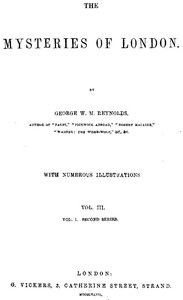
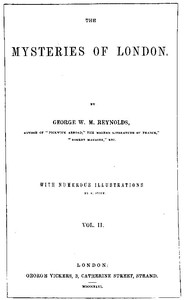
The Mysteries of London, v. 3/4 — Text and Context
(0 User reviews)
23
Project Gutenberg
2016
Not confirmed
London (England) -- Fiction; Penny dreadfuls
Readers of public-domain and historical texts
Project Gutenberg digital edition
en
Edition facts
Words
442,973
Reading time
1926 min
Text sections
118
The catalog record for The Mysteries of London, v. 3/4 — Text and Context provides practical reading context through 442,973 words, 32 hr 6 min estimated reading time, and 118 detected text sections.
The text analysis averages about 21.8 words per sentence, while the detected sections provide another way to judge how the source is divided.
Project Gutenberg metadata also associates the work with “London (England) -- Fiction,” connecting these edition facts with the source record’s subject description.
Source:
Project Gutenberg record #52056
Reynolds's serial novel uses dense plotting, moralized dialogue, and a network of spies and informants to expose London's criminal underworld. This volume follows the conspiracy against Thomas Rainford, with characters like Old Death and Mrs. Bunce orchestrating his arrest through bribes and surveillance.
Editorial Edition Score
4.9/5
★★★★★
★★★★★
Calculated from edition completeness, EPUB availability, text structure and catalogue metadata. Not a user rating.
How this score is calculated
- Description quality20 pts
- Title & short description10 pts
- Source metadata20 pts
- Text length15 pts
- Chapters / structure15 pts
- EPUB file integrity20 pts
Total of 100 points, scaled to a 2.5-5.0 range. Editions with an empty description or a missing EPUB file are not scored.
Edition quality
Read the Text
the principal hotel in the little town of Staines.
The inmates of the vehicle were two ladies:—an elderly domestic in livery and a female attendant occupied the box.
The night was clear, fine, and frosty: the moon shone brightly; and the carriage lamps threw a strong glare to a considerable distance in front of the vehicle.
The active ostlers speedily unharnessed the four wearied steeds, and substituted as many fresh ones in their place: the two postboys leapt into their saddles; the landlord cried "All right!"—and the carriage rolled rapidly away from the inn, the horses' shoes striking fire against the stones.
"If there be any thing particularly calculated to raise the spirits," said one lady to the other, a few minutes after the chariot had left the peaceful town behind, "it is travelling upon such a beauteous night as this."
"I am delighted to observe that you _are_ in good spirits this evening, my dear Lady Hatfield," was the reply. "After passing four long months at Sir Ralph Walsingham's country seat, London will present fresh attractions for your ladyship."
"My dear Miss Mordaunt," returned Lady Hatfield, in a serious tone, "you are aware that I am indifferent to those formal parties and ceremonial assemblies which are reckoned amongst the pleasures of the fashionable world; and I can assure you that had not my uncle purported to return to London in a few days, my own inclinations would have urged me to prolong my stay at Walsingham Manor."
"For my part," said Miss Mordaunt, "I am quite delighted with the idea of hastening back to the great metropolis. A summer in the country is only tolerable because each day brings one nearer to the enjoyments of a winter in town. But really, my dear Lady Hatfield, you are not reasonable. Rich, young, and beautiful as you are—your own mistress—and with the handsomest man in England dying to lay his coronet at your feet——"
"I shall never marry, Julia," hastily interrupted Lady Hatfield. "Pray let us change the conversation. A few minutes ago I was in excellent spirits; and now——"
She paused—and a deep sigh escaped her bosom.
"Did I not say that you were quite unreasonable?" exclaimed her companion. "Here am I—five years older than yourself,—for I do not mind telling you, my dear friend, that I shall never see thirty again;—and yet I have not renounced the idea of changing my condition. I know that I am neither so good-looking nor so wealthy as you;—still I have my little ambition. Sir Christopher Blunt would deem himself honoured were I to smile graciously upon him; but my brother, the lieutenant—who, by the by, expects his captaincy in a few days, thanks to the interest of your kind uncle Sir Ralph—declares that if ever I marry a mere knight, he will never speak to me again."
Lady Hatfield had fallen into a profound reverie, and paid not the slightest regard to the confidential outpourings of her garrulous companion.
Miss Mordaunt, who laboured under the pleasing impression that Lady Hatfield's silence was occasioned by the deep interest which she took in the present topic, continued to rattle away with her tongue as fast as the carriage did with its wheels.
"I am sure it was a very great act of kindness in you to ask me to spend the winter with you in London; for as papa is compelled to reside in Ireland, in consequence of the unsettled state of his tenantry, I should have been under the necessity of returning to the Emerald Isle, after my four months' visit with you to Walsingham Manor, had you not taken that compassion on me. But let us speak of yourself, dear Lady Hatfield. Without a soul in the world to control your actions—with the means of procuring every enjoyment—and with Lord Ellingham going mad on your account——"
"Julia," said Lady Hatfield, with a start,—"again I beseech you to drop this subject. And, as you will be my companion for some months to come, let me now, once for all, enjoin you to abstain from such topics. As you cannot read the secrets of my heart, pray bear in mind the fact that many a light word uttered thoughtlessly and with no malicious intent, may touch a chord that will thrill," she added calmly, but bitterly, "to the inmost recesses of my soul."
Reynolds builds his conspiracy through a chain of small, deliberate actions: a bribe to a lawyer, a spy stationed in a lane, a runner dispatched at night. The passage detailing the plot against Thomas Rainford reveals how the author distributes knowledge unevenly among characters—Mrs. Bunce knows Old Death is alive, Jacob Smith feigns ignorance, and the reader watches each piece fall into place. This technique, common in serial fiction, rewards attention to who knows what and when.
The prose itself mirrors the labyrinthine plot: long, clause-heavy sentences pile up circumstances and motives, as when the narrator recounts how Tidmarsh bribed Mr. Howard, how Dykes was instructed, and how Rainford was dogged to his abode. Reynolds rarely lets a single action stand alone; each is embedded in a chain of cause and effect, giving the novel a dense, almost legalistic texture.
The Mechanics of Surveillance
Reynolds populates his London with watchers and informants who turn the city into a network of observation. In the excerpt, Mrs. Bunce meets Rainford by accident in Gray's-Inn-Lane, then tries to follow him; when he disappears, she sets Jacob to watch the neighbourhood. The author specifies the days and times—Saturday night, Sunday evening—as if recording evidence. This precision gives the fictional conspiracy a documentary feel, as though the novel were a case file.
The spies themselves are ordinary: a lad, a woman, a runner. Reynolds does not romanticize them. They work for money, and their methods are mundane—knocking at every house, loitering in a lane. The effect is to make criminal enterprise seem like a business, with schedules, payments, and reports. Readers of serial fiction would recognize this as a variant of the urban gothic, but Reynolds grounds it in recognizable social practices.
Moralized Outbursts and Their Function
When Arthur, the Earl of Ellingham, confronts the conspirators, his speech shifts from exposition to denunciation: “Monsters that ye are! … what vengeance do ye not merit at my hands?” The outburst is theatrical, but it serves a structural purpose. In a serial novel published in weekly or monthly parts, such moments provide emotional climax and moral clarity. Reynolds uses them to punctuate long stretches of plot mechanics, reminding readers which side to support.
Yet Arthur immediately rejects vengeance: “vengeance is for cowards and grovelling miscreants like yourselves.” This turn is characteristic of Reynolds’s moral framework. His virtuous characters often articulate a code of restraint, even when provoked. The contrast between their self-control and the conspirators’ scheming reinforces the novel’s ethical binary, even as the plot grows increasingly tangled.
Diction of Deception and Revelation
Reynolds’s vocabulary in the conspiracy passage leans heavily on words of concealment and disclosure: “not to trust,” “misled her purposely,” “dogged,” “spies,” “confession,” “extorted.” The narrator describes the plot as “minutely—I may almost say, scientifically planned.” The adverb “scientifically” is striking; it suggests a methodical, almost rational evil, as opposed to impulsive crime. This diction aligns with the penny dreadful tradition, where villains often possess a cold intelligence.
Dialogue, too, carries this weight. When Arthur speaks of “infernal talent for wicked combinations,” the phrase combines admiration and horror. Reynolds does not let his villains explain themselves at length; instead, their motives are inferred from actions and from the narrator’s commentary. The result is a world where evil is both systematic and opaque, requiring the reader to piece together intentions from fragments.
The Role of the Confession Scene
The excerpt culminates in a confession “partly elicited fairly and partly extorted” from Old Death, Mrs. Bunce, and Tidmarsh. This scene is a set piece of Victorian sensation fiction: the captive villains, the righteous accuser, the detailed recapitulation of their crimes. Reynolds uses the confession to summarize and clarify the plot for readers who may have missed earlier installments. It is a narrative convenience, but also a moral ritual—the truth must be spoken aloud.
Notably, the confession is not voluntary. The phrase “extorted” hints at coercion, though the text does not specify what pressure was applied. This ambiguity is typical of Reynolds’s handling of justice: the line between lawful and unlawful action blurs. Arthur threatens to “imprison ye for the remainder of your lives in your own dungeons” or “set fire to the house.” The reader is left to wonder whether the ends justify these means.
Reynolds’s prose rewards attention to small details: a street name, a day of the week, a character’s hesitation. The novel’s length—over 440,000 words—means that patterns emerge slowly. Readers may find it useful to track the network of informants and the timing of events, as the author often withholds key information until a later chapter. The moral framework is clear, but the plot’s machinery is intricate enough to sustain multiple readings.
That grey afternoon, I kept returning to the way Reynolds’s spies tucked their bribes into folded newspapers, each exchange tightening the noose around Rainford. I closed the volume feeling watched myself, until I drifted to The Key Note: A Novel — Reading Notes, whose quieter, interior betrayals felt like the same fog, only turned inward.
There are no reviews for this eBook.
There are no comments for this eBook.
Reader reflection
Before you leave, reflect on the book
Use these questions to collect your thoughts before moving on.
Your progress
0
/
10
2
How did the book work for you overall?
3
Would you pass this book on to a friend?
4
What was the reading difficulty like?
5
Did the book meet your expectations?
6
Was the book moving at the right speed?
7
How personally connected did you feel to the book?
8
How valuable was this book for your own interests?
9
Which lesson or insight stayed with you?
10