1

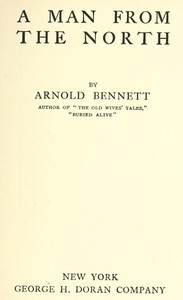
A Man from the North — Reading Notes
(0 User reviews)
3189
Project Gutenberg
2016
Not confirmed
London (England) -- Fiction; England -- Fiction; Man-woman relationships -- Fiction
Readers of public-domain and historical texts
Project Gutenberg digital edition
en
Edition facts
Words
55,489
Reading time
242 min
Text sections
6
This digital edition of A Man from the North — Reading Notes is described by source-level measurements including 55,489 words, 4 hr 2 min estimated reading time, and 6 detected text sections.
The text analysis averages about 15.5 words per sentence, while the detected sections provide another way to judge how the source is divided.
Project Gutenberg metadata also associates the work with “London (England) -- Fiction,” connecting these edition facts with the source record’s subject description.
Source:
Project Gutenberg record #52247
Arnold Bennett's early novel follows a young man from the North Country who moves to London, tracing his ambitions and relationships through precise shifts in narrative pace and voice, from aspirational longing to the constrained rhythms of lodgings and illness.
Editorial Edition Score
4.7/5
★★★★★
★★★★★
Calculated from edition completeness, EPUB availability, text structure and catalogue metadata. Not a user rating.
How this score is calculated
- Description quality20 pts
- Title & short description10 pts
- Source metadata20 pts
- Text length15 pts
- Chapters / structure15 pts
- EPUB file integrity20 pts
Total of 100 points, scaled to a 2.5-5.0 range. Editions with an empty description or a missing EPUB file are not scored.
Edition quality
Read the Text
Tea was brought in by a girl whose face proclaimed her to be Mrs. Rowbotham's daughter. At the sight of her Richard privately winked; he had read in books about landladies' daughters, but this one gave the lie to books; she was young, she was beautiful, and Richard would have sworn to her innocence. With an accession of boldness which surprised himself, he inquired her name.
"Lily, sir," she said, blushing like her mother.
He cut the new, heavy bread, and poured out a cup of tea with the awkwardness of one unaccustomed to such work, and, having made space on the tray, set the evening paper against the sugar basin, and began to eat and read. Outside were two piano organs, children shouting, and a man uttering some monotonous unintelligible cry. It grew dark; Mrs. Rowbotham came in with a lamp and cleared the table; Richard was looking through the window, and neither spoke. Presently he sat down. That being his first night in London, he had determined to spend it quietly _at home_. The piano organs and the children were still strident. A peculiar feeling of isolation momentarily overcame him, and the noises of the street seemed to recede. Then he went to the window again, and noticed that the children were dancing quite gracefully; it occurred to him that they might be ballet children. He picked up the paper and examined the theatrical advertisements, at first idly, but afterwards in detail.
With a long sigh, he took his hat and stick, and went very slowly downstairs. Mrs. Rowbotham heard him fumbling with the catch of the front door.
"Are you going out, sir?"
"Only just for a walk," said Richard, nonchalantly.
"Perhaps I'd better give you a latch-key?"
Another moment and he was in the delicious streets, going east.
Although he had visited London but once before, and then only for a few hours, he was not unfamiliar with the topography of the town, having frequently studied it in maps and an old copy of Kelly's directory.
He walked slowly up Park Side and through Piccadilly, picking out as he passed them the French Embassy, Hyde Park Corner, Apsley House, Park Lane, and Devonshire House. As he drank in the mingled glare and glamour of Piccadilly by night,--the remote stars, the high sombre trees, the vast, dazzling interiors of clubs, the sinuous, flickering lines of traffic, the radiant faces of women framed in hansoms,--he laughed the laugh of luxurious contemplation, acutely happy. At last, at last, he had come into his inheritance. London accepted him. He was hers; she his; and nothing should part them. Starvation in London would itself be bliss. But he had no intention of starving! Filled with great purposes, he straightened his back, and just then a morsel of mud thrown up from a bus-wheel splashed warm and gritty on his cheek. He wiped it off caressingly, with a smile.
Although it was Saturday night, and most of the shops were closed, an establishment where watches and trinkets of "Anglo-Spanish" gold, superb in appearance and pillowed on green plush, were retailed at alluring prices, still threw a brilliant light on the pavement, and Richard crossed the road to inspect its wares. He turned away, but retraced his steps and entered the shop. An assistant politely inquired his wishes.
"I want one of those hunters you have in the window at 29/6," said Richard, with a gruffness which must have been involuntary.
"Yes, sir. Here is one. We guarantee that the works are equal to the finest English lever."
"I'll take it." He put down the money.
"Thank you. Can I show you anything else?"
"Nothing, thanks," still more gruffly.
"We have some excellent chains...."
"Nothing else, thanks." And he walked out, putting his purchase in his pocket. A perfectly reliable gold watch, which he had worn for years, already lay there.
The novel opens with a distinctive, almost anthropological voice that describes a type: the Northern youth 'born to be a Londoner.' The narrator adopts a collective 'he' that generalizes but also individualizes through concrete details—watching the London train, envying the stoker, knowing West-end theatre bills by heart. This opening establishes a rhythm of yearning that will later give way to the more compressed, observational prose of London lodgings.
Once Richard arrives in Raphael Street, the narrative pace slows. The cab swings 'unsteadily,' the window bangs 'with a sharp bang,' and the landlady's 'yellow, crinkled face' and 'warm, benevolent smile' are registered in careful, almost tactile detail. Bennett shifts from the sweeping generalities of the first chapter to a close, patient attention to domestic surfaces and social cues.
The Weight of a Single Gesture
Bennett builds character through small, deliberate actions. When Richard first meets his landlady, he offers his hand; she wipes hers on her apron before shaking it. The gesture is noted without comment, but it carries the entire social distance between them—her deference, his awkward power. Later, the nurse reverses a stained wristband 'under his very gaze,' a tiny, almost theatrical adjustment that reveals both her professionalism and her self-consciousness. These moments accumulate into a portrait of a world where status is performed through minute bodily negotiations.
The dialogue, too, is freighted with implication. Miss Roberts's question—'You've noticed it too, have you?'—about Adeline's standoffishness is a trap that Richard sidesteps with a careful 'Not a bit.' The exchange is a dance of indirection, each character measuring what to reveal. Bennett's ear for these conversational feints gives the novel a psychological density that belies its straightforward plot.
Illness as a Change of Tempo
When Mr. Aked falls ill, the narrative rhythm shifts again. The doctor's clinical recitation—'double basic pneumonia, with fever, and cardiac complications, pulse 140, respiration 40, temperature 103 to 104'—introduces a stark, medical vocabulary that contrasts with the earlier, more lyrical descriptions of London. The pace becomes urgent, fragmented. Richard moves between Carteret Street and his lodgings, and the prose follows him in short, declarative sentences: 'He did not stay long. Mr. Aked's condition was unchanged.'
Bennett uses the illness to compress time and heighten the stakes. The nurse's 'dark, twinkling eyes' and 'astonishingly small white ears' are observed with the same precision as the landlady's curtsey, but now the details are charged with a new gravity. The novel's tempo, which began with the slow, patient accumulation of a young man's dreams, accelerates into a series of bedside vigils and whispered consultations.
Voice and the Unspoken
Throughout the excerpts, Bennett's narrator maintains a cool, slightly ironic distance. The opening description of the Northern youth—'he finds it difficult to keep from throwing himself in the guard's van'—is both sympathetic and gently mocking. This voice persists even in moments of crisis. When Richard meets the doctor, the narrator reports the medical details without emotional commentary, leaving the reader to infer the weight of the situation.
The dialogue is where the unspoken lives. Miss Roberts's question about Adeline—'Of course you like her?'—is a probe, and Richard's reply—'I scarcely know her—it's the old man I know'—is a deflection. The nurse's question—'I suppose you know the Akeds pretty well?'—is met with the same careful evasion: 'Well, pretty well.' Bennett's characters speak around their feelings, and the narrator lets their silences speak. This restraint gives the novel its particular tension: the reader must listen for what is not said.
Readers attentive to narrative voice will find Bennett's early style already assured in its shifts—from the generalizing sweep of the opening to the intimate, almost clinical observation of illness and domestic life. The novel rewards attention to small gestures and conversational indirection. As you read, note how the pace changes with each new setting: the train station, the lodging house, the sickroom. Each space imposes its own rhythm, and Bennett's prose adapts accordingly.
That ache in A Man from the North—the way ambition narrows into a rented room—stayed with me long after. It reminded me of another quiet story, Bobbie, General Manager: A Novel — Inside the Classic, where duty wraps around a person until it feels like skin. Sometimes a book just sits beside you, not solving anything, just keeping company.
There are no reviews for this eBook.
There are no comments for this eBook.
Reader reflection
Record your reading impressions
A brief reflection can help important ideas stay with you longer.
Your progress
0
/
10
2
How much did you enjoy the reading experience?
3
Would you recommend this book to another reader?
4
How much effort did this book require?
5
How did the reading compare with what you expected?
6
Did you relate to its people, ideas, or situations?
7
Which aspect of the book did you value most?
8
Did you gain anything practical from the text?
9
What changed or sharpened your thinking?
10