1

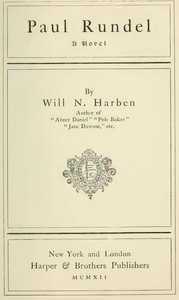
Paul Rundel: A Novel — Edition Insights
(0 User reviews)
640
Project Gutenberg
2016
Not confirmed
Ku Klux Klan (19th century) -- Fiction; Fugitives from justice -- Fiction; Georgia -- Fiction
Readers of public-domain and historical texts
Project Gutenberg digital edition
en
Edition facts
Words
117,291
Reading time
510 min
Text sections
13
This digital edition of Paul Rundel: A Novel — Edition Insights is described by source-level measurements including 117,291 words, 8 hr 30 min estimated reading time, and 13 detected text sections.
The text analysis averages about 15.6 words per sentence, while the detected sections provide another way to judge how the source is divided.
Project Gutenberg metadata also associates the work with “Ku Klux Klan (19th century) -- Fiction,” connecting these edition facts with the source record’s subject description.
Source:
Project Gutenberg record #50898
In this 1912 novel set in the Georgia mountains, Will N. Harben traces Paul Rundel's conflicts with the Ku Klux Klan and his own nature-worship ideals, using sharp domestic dialogue and a tense letter scene to reveal hidden fears.
Editorial Edition Score
4.9/5
★★★★★
★★★★★
Calculated from edition completeness, EPUB availability, text structure and catalogue metadata. Not a user rating.
How this score is calculated
- Description quality20 pts
- Title & short description10 pts
- Source metadata20 pts
- Text length15 pts
- Chapters / structure15 pts
- EPUB file integrity20 pts
Total of 100 points, scaled to a 2.5-5.0 range. Editions with an empty description or a missing EPUB file are not scored.
Edition quality
Read the Text
the joy of it that I just naturally wanted to grab up every baby I met and hug it. I never could hear a child cry over a stubbed toe, a stone-bruise, or any little disappointment without actually achin' at the heart. But our son was taken, Paul, taken right when he was the very light an' music of our lives. And, my boy, let me tell you, if ever a Christian come nigh wagin' open war with his Maker I did on that day. God looked to me like a fiend incarnate, and His whole universe, from top to bottom, seemed a trap to catch an' torture folks in. But as time passed somehow my pain growed less, until now I am plumb resigned to the Lord's will. He knowed best. Yes, as I say, I always felt a big interest in you, and have prayed for you time after time, for I know your life is a tough uphill one. Paul, I hope you will excuse me, but a thing took place out thar in front of my window just now that--”
A grunt of somnolent rage escaped the boy, and Silas saw him clench his fist. His voice quivered with passion: “Them two devils have been picking at me for more than a year, calling me names and throwing rocks at me from behind fences. Yesterday they made fun of my father, and so I got ready, and--”
“I know, I know!”--the shoemaker sighed, reproachfully--“and so you deliberately, an' in a calm moment, laid that gun on yore load of bark, and--”
“Yes, and both barrels was loaded with heavy buck-shot!” the boy exulted, his tense face afire, his eyes flashing, “and if they hadn't run like two cowardly pups I'd have blowed holes in 'em as big as a hat.”
Silas made a derogatory sound with his tongue and lips. “Oh, how blind you was, my pore boy--you was too mad to see ahead; folk always are when they are wrought up. Paul, stop for one minute and think. If you had killed one or both of 'em, that wouldn't have settled the trouble. You don't think so now, but you'd have gone through bottomless pits of remorse. The Lord has made it that way. Young as you are, you'd have died on the scaffold, or toiled through life as a convict, for it would have been murder, and deliberate at that.”
The youth shrugged his thin shoulders. “I wouldn't have cared,” he answered. “I tell you it ain't ended, Uncle Si. Them fellows has got to take back what they said about my father. They've got to take it back, I tell you! If they don't, I'll kill 'em if it takes a lifetime to do it. I'll kill 'em!”
Silas groaned. A pained look of concern gathered in his mild eyes. He reached for the polishing-iron which was being heated in the flame of a smoking lamp on his bench and wiped it on his dingy apron. “It won't do!” he cried, and his bald head seemed drawn down by fear and anxiety. “Something has got to be done; they are a pair of low, cowardly whelps that are try in' to bully you, but you've got to quit thinkin' about murder. It won't do, I say; the devil is behind it. You stand away above fellows like them. You've got the makin' of a big man in you. You love to read and inquire, and they don't know their a b c's and can't add two figures. You mustn't lower yourself to such riffraff, and you wouldn't if you didn't let the worst part o' yourself get the upper hand.”
When the boy had left the shop Silas stood watching him from the doorway. It was a pathetic figure which climbed upon the load of bark, and swung the long whip in the air.
“What a pity! What a pity!” the old man exclaimed, and he wrung his hands beneath his apron; then seating himself on his bench he reluctantly resumed his work. “As promising as he is, he may go clean to the dogs. Poor boy!”
|IT was now near noon, as was indicated by the clock on the low, dome-capped tower of the Court House in the center of the village square. Paul recognized several idlers who stood on a street-corner as he drove past. They looked at him and smiled approvingly, and one cried out:
“Bully for you, Paul! You are all wool and a yard wide.”
The novel opens not with Paul Rundel but with a sharp domestic exchange between Cynthia Tye and her husband Silas, a shoemaker in the mountain village of Grayson. Cynthia, gaunt and thin, presses her gnarled fingers on her hips as she demands to know what Silas wants for dinner; he, rotund and bald, laughs at her habit of planning meals hours ahead. Their banter—Cynthia’s worry over souring food and the cat, Silas’s preference for a boarding-house—establishes a voice grounded in everyday friction. This domestic texture soon gives way to Paul’s own voice: he is a nature-worshiper who sees the valley as a “vague dream-spot” and carries a manuscript of his fancies. The contrast between the shoemaker’s shop and Paul’s reverie sets up a world where practical survival and romantic idealism coexist uneasily.
Domestic Tensions and the Shoemaker’s Shop
The opening scene in Silas Tye’s shop is a masterclass in marital sparring. Cynthia’s thinness and gnarled fingers are set against Silas’s surplus flesh and “genial pate as bald as an egg.” Their argument over dinner planning reveals a household where labor is gendered and resented: Cynthia must pick, prepare, and worry over food, while Silas sits humped over his last, hammer, and knife. The dialogue is peppered with colloquialisms—“chock full o’ breakfast,” “hit or miss”—and the physical comedy of Silas laughing till his tools rattle. This is not mere scene-setting; it establishes a pattern of tension that will recur throughout the novel. The shop itself, with its leather apron and scattered nails, becomes a symbol of the constrained, repetitive labor that Paul Rundel, with his nature-worship and manuscript, seems to flee.
Nature-Worship and the Dream-Spot
Paul Rundel is introduced as a “nature-worshiper” who feels Nature has wrapped her “robe of enchantment” about him. The sky is bluer than ever; space holds “hints of the Infinite.” He notices every flower and the color of the gray-brown soil. The valley is a “vague dream-spot ever receding from his grasp.” This language is deliberately heightened, contrasting sharply with the earthy, practical speech of the Tyes. Paul carries a manuscript of his own fancies and plans to discuss it with Ethel. Yet the narrative undercuts his reverie: he returns home at dusk to find Ethel agitated, holding a letter. The transition from pastoral bliss to anxious news is abrupt, suggesting that Paul’s idealism is fragile, easily punctured by real-world worries. The excerpt does not reveal whether his nature-worship is a genuine philosophy or a form of escape.
The Letter and the Fear of Loss
Ethel’s letter from her aunt brings a crisis that tests Paul’s sympathy. Ethel speaks of thought-transference, claiming she and her cousin Jennie used to think of the same things at the same time. She is convinced Jennie is dying, even though the letter says she is “doing as well as could be expected.” Paul tries to console her, but his words are halting: “Oh, I hope you won’t lose hope.” The narrative notes that “there was nothing Paul could do or say.” Mrs. Tilton later reveals a telegram has arrived—the doctors have given up—but Ethel has not been told. This layering of information (letter, telegram, hidden truth) creates a sense of impending grief. The scene is notable for what it does not show: Paul’s inner thoughts. He stands “still and mute,” a storm of pain within him, but the reader is kept at a distance. The tension between what is said and what is withheld becomes a structural pattern.
The excerpts offer a novel built on contrasts: the cramped shop versus the open valley, practical worry versus romantic idealism, spoken words versus hidden telegrams. Readers may find that Harben’s strength lies in these juxtapositions rather than in any single character’s arc. Pay attention to how domestic details—a shoemaker’s tools, a meal plan, a folded letter—carry emotional weight. The Ku Klux Klan, listed as a catalog subject, does not appear in these passages, so its role remains a looming question. Approach the text as a study in how ordinary life and extraordinary fear intersect.
Reading about Paul Rundel’s hidden fears in that tense letter scene, I remembered sitting on my grandmother’s porch, turning pages as dusk settled, the same tightness in my chest. The Dorrington Deed-Box — Reading Companion once gave me that quiet dread, where every unlocked drawer felt like a confession I wasn’t ready for. Some stories just wait for you to catch up.
There are no reviews for this eBook.
There are no comments for this eBook.
Reader reflection
How will you remember this book?
Save your reaction, strongest insight, and memorable passage.
Your progress
0
/
10
2
Did this book hold your interest?
3
Would you recommend this book to another reader?
4
Did the language feel accessible?
5
Did the book offer a fresh perspective?
6
How strong was your personal connection to the text?
7
How useful did the reading feel?
8
Which aspect of the book did you value most?
9
In one sentence, what did you learn?
10