1

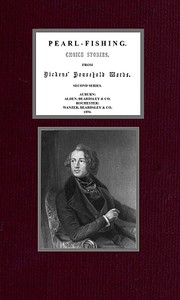
Pearl-Fishing; Choice Stories from Dickens' Household Words; Second Series — Background and Themes
(0 User reviews)
426
Project Gutenberg
2015
Not confirmed
English fiction -- 19th century; Short stories, English
Readers of public-domain and historical texts
Project Gutenberg digital edition
en
Edition facts
Words
66,885
Reading time
291 min
Text sections
7
This digital edition of Pearl-Fishing; Choice Stories from Dickens' Household Words; Second Series — Background and Themes is described by source-level measurements including 66,885 words, 4 hr 51 min estimated reading time, and 7 detected text sections.
The text analysis averages about 20.7 words per sentence, while the detected sections provide another way to judge how the source is divided.
Project Gutenberg metadata also associates the work with “English fiction -- 19th century,” connecting these edition facts with the source record’s subject description.
Source:
Project Gutenberg record #50334
Eight stories from Dickens' Household Words, selected for a second series, featuring French aristocrats, English gardeners, and moral tales. The excerpts show detailed social observation and character-driven plots, though the full range of the collection remains unseen.
Editorial Edition Score
4.7/5
★★★★★
★★★★★
Calculated from edition completeness, EPUB availability, text structure and catalogue metadata. Not a user rating.
How this score is calculated
- Description quality20 pts
- Title & short description10 pts
- Source metadata20 pts
- Text length15 pts
- Chapters / structure15 pts
- EPUB file integrity20 pts
Total of 100 points, scaled to a 2.5-5.0 range. Editions with an empty description or a missing EPUB file are not scored.
Edition quality
Read the Text
another lover more nearly of her own condition of life; this was Claperon, the deputy-governor of the Rouen jail, with whom she made acquaintance during one or two compulsory visits paid by her brother to that functionary; but Claudine, who was a bit of a coquette, though she did not altogether reject his suit, gave him little encouragement, so that betwixt hopes, and fears, and doubts, and jealousies, poor Claperon led a very uneasy kind of life.
Affairs had been for some time in this position, when, one fine morning, Alphonse de Bellefonds was not to be found in his chamber when his servant went to call him; neither had his bed been slept in. He had been observed to go out rather late on the preceding evening, but whether or not he had returned, nobody could tell. He had not appeared at supper, but that was too ordinary an event to awaken suspicion; and little alarm was excited till several hours had elapsed, when inquiries were instituted and a search commenced, which terminated in the discovery of his body, a good deal mangled, lying at the bottom of a pond which had belonged to the old brewery. Before any investigations had been made, every person had jumped to the conclusion that the young man had been murdered, and that Jacques Rollet was the assassin. There was a strong presumption in favor of that opinion, which further perquisitions tended to confirm. Only the day before, Jacques had been heard to threaten M. de Bellefonds with speedy vengeance. On the fatal evening, Alphonse and Claudine had been seen together in the neighborhood of the now dismantled brewery; and as Jacques, betwixt poverty and democracy, was in bad odor with the prudent and respectable part of society, it was not easy for him to bring witnesses to character, or prove an unexceptionable alibi. As for the Bellefonds and De Chaulieus, and the aristocracy in general, they entertained no doubt of his guilt; and finally, the magistrates coming to the same opinion, Jacques Rollet was committed for trial, and as a testimony of good will Antoine de Chaulieu was selected by the injured family to conduct the prosecution.
Here, at last, was the opportunity he had sighed for! So interesting a case, too, furnishing such ample occasion for passion, pathos, indignation! And how eminently fortunate that the speech which he set himself with ardor to prepare, would be delivered in the presence of the father and brother of his mistress, and perhaps of the lady herself! The evidence against Jacques, it is true, was altogether presumptive; there was no proof whatever that he had committed the crime; and for his own part he stoutly denied it. But Antoine de Chaulieu entertained no doubt of his guilt, and his speech was certainly well calculated to carry conviction into the bosom of others. It was of the highest importance to his own reputation that he should procure a verdict, and he confidently assured the afflicted and enraged family of the victim that their vengeance should be satisfied. Under these circumstances could anything be more unwelcome than a piece of intelligence that was privately conveyed to him late on the evening before the trial was to come on, which tended strongly to exculpate the prisoner, without indicating any other person as the criminal. Here was an opportunity lost. The first step of the ladder on which he was to rise to fame, fortune, and a wife, was slipping from under his feet!
Of course, so interesting a trial was anticipated with great eagerness by the public, and the court was crowded with all the beauty and fashion of Rouen. Though Jacques Rollet persisted in asserting his innocence, founding his defence chiefly on circumstances which were strongly corroborated by the information that had reached De Chaulieu the preceding evening,--he was convicted.
The eight stories in this second series of Pearl-Fishing were originally published in Dickens' Household Words and selected for an American audience in 1854. The excerpts reveal a collection that balances social commentary with domestic drama, often focusing on characters caught between economic pressure and personal desire. In 'The Young Advocate,' the opening story, the enmity between Antoine de Chaulieu and Jacques Rollet is established through class markers—genealogy versus purse, refinement versus brute strength—that drive the narrative forward. Later, 'The Home of Woodruffe the Gardener' shifts to a quieter English setting, where a husband's impulsive land purchase and his wife's cautious pragmatism create a tension that feels both intimate and emblematic of broader changes in rural life.
Class and Character in the Opening Tale
The first story, 'The Young Advocate,' introduces its conflict through a series of antitheses: Antoine de Chaulieu is 'delicate and refined,' the son of a poor gentleman with a 'long genealogy' and 'short rent-roll'; Jacques Rollet is 'sturdy and rough,' with a 'long purse' and no known grandfather. The schoolmaster favors the aristocrat, while Rollet is flogged for quarrelling. These details establish a world where birth and money are in constant tension, and the narrator's tone—noting the master was 'a bit of an aristocrat in his heart'—suggests an ironic awareness of how class prejudice operates even in revolutionary times. The story then follows Antoine to Paris to study law, where 'reaction in favor of birth and nobility' allows him to advance. The excerpts do not reveal the resolution, but the setup is rich with social observation.
Domestic Negotiation in the Gardener's Tale
'The Home of Woodruffe the Gardener' offers a contrasting domestic drama. Woodruffe, facing eviction from his leased garden, proposes to buy land sight unseen based on his daughter's description. His wife resists: 'I would just wait till then.' The dialogue captures a marriage of opposing temperaments—Woodruffe impulsive, his wife cautious—as he enumerates the land's advantages: 'aspect capital,' 'soil anything but poor,' 'manure at command.' Yet the wife's quiet persistence ('I see none now, and I only want to be sure') hints at a deeper anxiety. The story also notes external pressures: a railway has shifted vegetable supply, making market-gardening less profitable. This intertwining of personal and economic forces gives the tale a documentary quality, grounded in the specifics of 1850s rural change.
Structure and Selection Across the Collection
The table of contents lists eight stories, from 'The Young Advocate' to 'An Excellent Opportunity,' but the excerpts provide only two complete openings. The collection's title—Pearl-Fishing—suggests a deliberate sifting of gems from the larger Household Words corpus. The publisher's notice claims 'large demand' for the first series and promises this volume will be 'not less interesting and worthy of attention.' Yet the catalog subjects—'English fiction -- 19th century; Short stories, English'—are broad, and the excerpts show a range of settings: a French revolutionary-era school, an English gardener's cottage. Without reading the full text, it is impossible to assess the collection's thematic unity or the quality of the remaining six stories. The evidence points to a miscellany of moral and social tales, but the selection principle remains opaque.
Readers approaching this collection should note that the excerpts offer only a partial view. The two stories sampled suggest a preoccupation with class, money, and domestic decision-making, but the other six tales may introduce different subjects or styles. Pay attention to how each story handles its central conflict—whether through dialogue, narration, or moral commentary—and consider how the American publisher's selection might have shaped the collection's tone. The absence of a unifying authorial voice (Dickens is credited as editor, not sole author) invites curiosity about the contributors and their range.
Reading these Dickens household tales, I remembered my grandfather’s quiet evenings with a worn paperback, the same unhurried moral weight settling over the room. That warmth returned with By far Euphrates — Background and Themes, which once made me feel I was turning pages in a lamplight that never quite dimmed. Some stories just carry that gentleness, don’t they?
There are no reviews for this eBook.
There are no comments for this eBook.
Reader reflection
What was your reading experience?
Capture what you thought, learned, and would like to remember.
Your progress
0
/
10
2
What was your overall reaction to the book?
3
Would you recommend this book to another reader?
4
How demanding did the text feel?
5
Did this book create an emotional response?
6
Did it raise ideas you would like to talk about?
7
Was the book what you thought it would be?
8
Which part made the strongest impression?
9
What did this book teach you most?
10