1

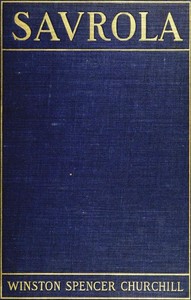
Savrola: A Tale of the Revolution in Laurania — Reading Notes
(0 User reviews)
2858
Project Gutenberg
2016
Not confirmed
Political fiction; Revolutions -- Fiction
Readers of public-domain and historical texts
Project Gutenberg digital edition
en
Edition facts
Words
61,004
Reading time
266 min
Text sections
6
The catalog record for Savrola: A Tale of the Revolution in Laurania — Reading Notes provides practical reading context through 61,004 words, 4 hr 26 min estimated reading time, and 6 detected text sections.
The text analysis averages about 15.4 words per sentence, while the detected sections provide another way to judge how the source is divided.
Project Gutenberg metadata also associates the work with “Political fiction,” connecting these edition facts with the source record’s subject description.
Source:
Project Gutenberg record #50906
An editorial note on Winston Churchill's only novel, examining the author's choices in diction, dialogue, and description through the opening chapter and a key conspiratorial scene, without claiming knowledge of the complete plot.
Editorial Edition Score
4.7/5
★★★★★
★★★★★
Calculated from edition completeness, EPUB availability, text structure and catalogue metadata. Not a user rating.
How this score is calculated
- Description quality20 pts
- Title & short description10 pts
- Source metadata20 pts
- Text length15 pts
- Chapters / structure15 pts
- EPUB file integrity20 pts
Total of 100 points, scaled to a 2.5-5.0 range. Editions with an empty description or a missing EPUB file are not scored.
Edition quality
Read the Text
AN EVENT OF POLITICAL IMPORTANCE.
There had been a heavy shower of rain, but the sun was already shining through the breaks in the clouds and throwing swiftly changing shadows on the streets, the houses, and the gardens of the city of Laurania. Everything shone wetly in the sunlight: the dust had been laid; the air was cool; the trees looked green and grateful. It was the first rain after the summer heats, and it marked the beginning of that delightful autumn climate which has made the Lauranian capital the home of the artist, the invalid, and the sybarite.
The shower had been heavy, but it had not dispersed the crowds that were gathered in the great square in front of the Parliament House. It was welcome, but it had not altered their anxious and angry looks; it had drenched them without cooling their excitement. Evidently an event of consequence was taking place. The fine building, where the representatives of the people were wont to meet, wore an aspect of sombre importance that the trophies and statues, with which an ancient and an art-loving people had decorated its façade, did not dispel. A squadron of Lancers of the Republican Guard was drawn up at the foot of the great steps, and a considerable body of infantry kept a broad space clear in front of the entrance. Behind the soldiers the people filled in the rest of the picture. They swarmed in the square and the streets leading to it; they had scrambled on to the numerous monuments, which the taste and pride of the Republic had raised to the memory of her ancient heroes, covering them so completely that they looked like mounds of human beings; even the trees contained their occupants, while the windows and often the roofs, of the houses and offices which overlooked the scene were crowded with spectators. It was a great multitude and it vibrated with excitement. Wild passions surged across the throng, as squalls sweep across a stormy sea. Here and there a man, mounting above his fellows, would harangue those whom his voice could reach, and a cheer or a shout was caught up by thousands who had never heard the words but were searching for something to give expression to their feelings.
It was a great day in the history of Laurania. For five long years since the Civil War the people had endured the insult of autocratic rule. The fact that the Government was strong, and the memory of the disorders of the past, had operated powerfully on the minds of the more sober citizens. But from the first there had been murmurs. There were many who had borne arms on the losing side in the long struggle that had ended in the victory of President Antonio Molara. Some had suffered wounds or confiscation; others had undergone imprisonment; many had lost friends and relations, who with their latest breath had enjoined the uncompromising prosecution of the war. The Government had started with implacable enemies, and their rule had been harsh and tyrannical. The ancient constitution to which the citizens were so strongly attached and of which they were so proud, had been subverted. The President, alleging the prevalence of sedition, had declined to invite the people to send their representatives to that chamber which had for many centuries been regarded as the surest bulwark of popular liberties. Thus the discontents increased day by day and year by year: the National party, which had at first consisted only of a few survivors of the beaten side, had swelled into the most numerous and powerful faction in the State; and at last they had found a leader. The agitation proceeded on all sides. The large and turbulent population of the capital were thoroughly devoted to the rising cause. Demonstration had followed demonstration; riot had succeeded riot; even the army showed signs of unrest. At length the President had decided to make concessions. It was announced that on the first of September the electoral writs should be issued and the people should be accorded an opportunity of expressing their wishes and opinions.
This pledge had contented the more peaceable citizens. The extremists, finding themselves in a minority, had altered their tone. The Government, taking advantage of the favourable moment, had arrested several of the more violent leaders. Others, who had fought in the war and had returned from exile to take part in the revolt, fled for their lives across the border. A rigorous search for arms had resulted in important captures. European nations, watching with interested and anxious eyes the political barometer, were convinced that the Government cause was in the ascendant. But meanwhile the people waited, silent and expectant, for the fulfilment of the promise.
Winston Churchill's only novel, Savrola: A Tale of the Revolution in Laurania (1900), opens with a description of a rain shower that simultaneously freshens the city and fails to cool the crowd's anger. The narrator notes that the rain 'drenched them without cooling their excitement,' a phrasing that juxtaposes physical relief with emotional intensity. This early choice establishes a pattern: the author uses weather and setting to mirror political tension, not as mere backdrop but as an active participant in the scene. The square is filled with soldiers and monuments 'covered so completely' by people that the statues seem to disappear—a visual compression that hints at the populace overwhelming the symbols of the state. Churchill's prose here is precise, favoring concrete nouns and active verbs over abstraction, and the dialogue that follows in later excerpts continues this tendency toward sharp, functional exchanges rather than ornate speeches.
Diction and the Weight of Words
Churchill's vocabulary in the excerpts is notably concrete and physical. Words like 'drenched,' 'crackle,' 'flicked out of human ken,' and 'limp and reproachful' ground abstract political conflict in bodily sensation. The narrator describes the room after a late-night meeting as 'like a woman, no longer young, surprised by an unsympathetic dawn in the meretricious paints and pomps of the previous night'—a simile that is both vivid and slightly jarring, suggesting a self-conscious literary ambition. The author avoids Latinate abstraction where possible; even 'the machinery of revolution' is a mechanical metaphor that keeps the reader in a tangible world. This preference for the concrete over the conceptual gives the prose a forward momentum, even when characters are reflecting on the meaning of their actions.
Dialogue as a Tool of Revelation
The dialogue in the conspiratorial scene is terse and functional. Savrola gives orders: 'wait till you get a written order from me,' 'wait till I give the word.' The repetition of 'wait' underscores the tension between preparation and action. Moret departs 'full of enthusiasm' while others are 'gloomy and preoccupied'—the contrast is shown, not explained. Churchill does not use dialogue to expound ideology; instead, it reveals temperament and hierarchy. Savrola's final line before the scene ends is not a rallying cry but a private question: 'What was the good of it all?' This shift from command to doubt, rendered in interior monologue rather than spoken word, suggests that the author is more interested in the psychological cost of leadership than in the mechanics of revolution.
Description and the Architecture of Anxiety
Churchill's descriptive passages often build a sense of enclosure and pressure. The Parliament House wears 'an aspect of sombre importance' that the trophies and statues 'did not dispel.' The crowd is not a faceless mass but a physical presence that 'filled in the rest of the picture,' covering monuments 'so completely that they looked like' something else—the simile is cut off in the excerpt, leaving a visual gap. Later, Savrola's room in the grey dawn is described with a simile that personifies the space as a woman caught off-guard, emphasizing decay and artifice. These descriptions do not merely set a mood; they create a world where objects and spaces carry emotional weight, and where the line between the human and the architectural blurs.
Structure and the Rhythm of Revolution
The excerpts show a careful alternation between panoramic crowd scenes and intimate private moments. The first chapter moves from the square to the Parliament steps to the interior, then jumps to a late-night meeting in a private home. This structural oscillation between public and private spaces mirrors the novel's concern with the relationship between mass action and individual decision. The author also uses time as a structural device: the rain 'marked the beginning' of autumn, and the meeting ends at dawn, with the first streaks of morning light. These temporal markers give the narrative a sense of inexorable progression, even as Savrola pauses to question the purpose of it all. The reader is left with the impression of a clock ticking toward an event that the text itself is reluctant to name.
Readers approaching Savrola should attend to the way Churchill uses physical detail—weather, architecture, the state of a room—to externalize internal conflict. The novel's political plot is carried forward not by lengthy debates but by the accumulation of sensory impressions and the weight of unspoken decisions. The excerpts suggest a work that is as much about the psychology of a leader as about the mechanics of revolt, and the author's choices in diction and description reward close attention to what is shown rather than told.
Years of shelving have taught me how two novels sometimes whisper to each other across the centuries. Savrola’s quiet study of revolutionary hearts finds an unexpected echo in Dorothy South: A Love Story of Virginia Just Before the War — Text and Context, where personal longing also brushes against a nation’s gathering storm. Both authors weigh every word like a held breath, letting atmosphere carry what plot leaves unsaid.
There are no reviews for this eBook.
There are no comments for this eBook.
Reader reflection
What did you think of this book?
Answer a few questions and save a private reflection on this device.
Your progress
0
/
10
2
How much did you enjoy the reading experience?
3
How likely are you to recommend this book?
4
How much effort did this book require?
5
Did the book offer a fresh perspective?
6
Do you expect to return to this book?
7
Did this book create an emotional response?
8
How did the reading compare with what you expected?
9
In one sentence, what did you learn?
10