1

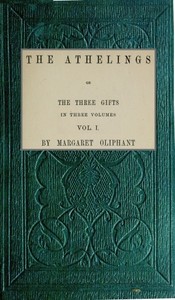
The Athelings; or, the Three Gifts. Vol. 1/3 — Reading Notes
(0 User reviews)
1723
Project Gutenberg
2017
Not confirmed
England -- Social life and customs -- 19th century -- Fiction; Siblings -- Fiction; Families -- Fiction
Readers of public-domain and historical texts
Project Gutenberg digital edition
en
Edition facts
Words
60,284
Reading time
263 min
Text sections
6
For The Athelings; or, the Three Gifts. Vol. 1/3 — Reading Notes, the stored edition analysis reports 60,284 words, 4 hr 23 min estimated reading time, and 6 detected text sections.
The text analysis averages about 22.6 words per sentence, while the detected sections provide another way to judge how the source is divided.
Project Gutenberg metadata also associates the work with “England -- Social life and customs -- 19th century -- Fiction,” connecting these edition facts with the source record’s subject description.
Source:
Project Gutenberg record #54510
Margaret Oliphant's novel opens with twin sisters in Islington, using precise diction and contrasting descriptions to establish character through appearance and dialogue, while a verbose American visitor debates the ethics of publicizing private lives.
Editorial Edition Score
4.7/5
★★★★★
★★★★★
Calculated from edition completeness, EPUB availability, text structure and catalogue metadata. Not a user rating.
How this score is calculated
- Description quality20 pts
- Title & short description10 pts
- Source metadata20 pts
- Text length15 pts
- Chapters / structure15 pts
- EPUB file integrity20 pts
Total of 100 points, scaled to a 2.5-5.0 range. Editions with an empty description or a missing EPUB file are not scored.
Edition quality
Read the Text
ition of the little garden before the door; but the bushes are somewhat straggling, and wave their long arms about in the rising wind. There is a window on either side of the door, and the house is but two stories high: it is the most commonplace of houses, perfectly comfortable and uninteresting, so far as one may judge from without. Inside, the little hall is merely a passage, with a door on either side, a long row of pegs fastened against the wall, and a strip of brightly-painted oil-cloth on the floor. The parlour door is open--there are but two candles, yet the place is bright; and in it is the lighted window which shines so cheerily into the silent street. The father sits by the fire in the only easy-chair which this apartment boasts; the mother moves about on sundry nameless errands, of which she herself could scarcely give a just explanation; yet somehow that comfortable figure passing in and out through light and shadow adds an additional charm to the warmth and comfort of the place. Two little children are playing on the rug before the fire--very little children, twins scarcely two years old--one of them caressing the slippered foot of Mr Atheling, the other seated upon a great paper book full of little pictures, which serves at once as amusement for the little mind, and repose for the chubby little frame. They are rosy, ruddy, merry imps, as ever brightened a fireside; and it is hard to believe they are of the same family as Charlie and Agnes and Marian. For there is a woeful gap between the elder and the younger children of this house--an interval of heavy, tardy, melancholy years, the records of which are written, many names, upon one gravestone, and upon the hearts of these two cheerful people, among their children at their own hearth. They have lived through their day of visitation, and come again into the light beyond; but it is easy to understand the peculiar tenderness with which father and mother bend over these last little children--angels of consolation--and how everything in the house yields to the pretty childish caprice of little Bell and little Beau.
Yes, of course, you have found it out: everybody finds it out at the first glance; everybody returns to it with unfailing criticism. To tell the truth, the house is a very cheap house, being so large a one. Had it been in good order, the Athelings could never have pretended to such a “desirable family residence” as this house in Bellevue; and so you perceive this room has been papered by Charlie and the girls and Mrs Atheling. It is a very pretty paper, and was a great bargain; but unfortunately it is not matched--one-half of the pattern, in two or three places, is hopelessly divorced from the other half. They were very zealous, these amateur workpeople, but they were not born paperhangers, and, with the best intentions in the world, have drawn the walls awry. At the time Mrs Atheling was extremely mortified, and Agnes overcome with humiliation; but Charlie and Marian thought it very good fun; Papa burst into shouts of laughter; Bell and Beau chorused lustily, and at length even the unfortunate managers of the work forgave themselves. It never was altered, because a new paper is an important consideration where so many new frocks, coats, and bonnets are perpetually wanting: everybody became accustomed to it; it was an unfailing source of family witticism; and Mrs Atheling came to find so much relaxation from her other cares in the constant mental effort to piece together the disjointed pattern, that even to her there was consolation in this dire and lamentable failure. Few strangers came into the family-room, but every visitor who by chance entered it, with true human perversity turned his eyes from the comfort and neatness of the apartment, and from the bright faces of its occupants, to note the flowers and arabesques of the pretty paper, wandering all astray over this unfortunate wall.
The novel begins not with a family hearth but with a street scene in Islington, where two sisters walk home in matching brown merino cloaks and bonnets. The narrator immediately distinguishes them: one is “very pretty,” her face “brighten[ing] like a passing sunbeam”; the other is “taller, paler,” and “not so bright of natural expression.” Their identical dress—down to the “fac-simile” pink rosebuds—underscores a surface sameness that the narrative voice promptly dismantles, promising a “characteristic difference in their looks and in their minds.” This opening gesture, at once descriptive and analytical, establishes Oliphant’s method: she will use small material details to probe inner lives.
Diction and the Divided Gaze
The narrator’s language oscillates between affectionate intimacy and cool assessment. The pretty sister, Marian, is described through metaphors of light and unconscious influence: “people smile when they pass her, unawares.” The other, Agnes, is introduced with a concessive “not very pretty,” then immediately qualified as “far from being commonplace.” This double movement—a surface judgment followed by a corrective—recurs throughout the excerpts. When Agnes listens to Mr. Endicott’s grand theories, she “held her breath, and suspended her work unawares,” a phrase that echoes the earlier description of Marian’s unconscious effect, but here applied to intellectual absorption rather than physical charm. Oliphant thus uses parallel diction to link the sisters while marking their distinct spheres: one draws smiles, the other draws ideas.
Voice and the American Visitor
Mr. Endicott, the American literary gentleman, speaks in a pompous, self-dramatizing register that Oliphant renders with precise comic effect. He declares that “a man of genius has no private life” and that “the poet himself is the great lesson of the world.” His speech is full of abstractions—“the path of genius,” “the true vocation of a poet”—and he uses the royal “we” to claim universal authority. The sisters respond in contrasting voices: Agnes with humble doubt (“Do you think it is right?”), Marian with concealed laughter. Harry Oswald’s blunt interjection—“come in, and punch this fellow’s head”—provides a deflating counterpoint. Oliphant uses dialogue not merely to advance plot but to expose character through verbal mannerism: Endicott’s grandiosity, Agnes’s earnestness, Marian’s mischief, Harry’s impatience.
Structure and the Interruption
The excerpts reveal a pattern of interrupted scenes. Chapter XIX begins with Charlie being summoned from his grammars, and the conversation is repeatedly broken by entrances and asides. Marian says “no one ever wants you, you disagreeable boy,” and Harry Oswald laughs behind her chair. Mrs. Atheling then interposes with a practical question about Harry’s employment. These interruptions are not mere filler; they structure the narrative as a series of overlapping domestic voices. Oliphant’s paragraphs often shift abruptly from one speaker to another, mimicking the rhythm of family talk. The effect is a crowded, lively texture where no single voice dominates for long—a formal choice that mirrors the novel’s interest in the interplay of personalities within a constrained social setting.
Setting as Social Marker
The opening chapter locates the story precisely: “This is Islington, a mercantile and clerkish suburb.” The street is “sombre,” the houses have “front gardens” with “smoky evergreens” and “flower-plots ignorant of flowers.” This is not a romanticized London; it is a specific, unglamorous geography of clerks and shopkeepers. The sisters’ thrifty dress—brown merino, little cloaks “exact to the same pattern”—signals their modest means. Later, the domestic interior is implied through references to work (Agnes suspends her sewing) and the presence of grammars on the table. Oliphant uses setting and costume as shorthand for social position, but she also makes them dynamic: the street is “cheery but cold,” the lamps begin to shine “through the ruddy twilight.” These sensory details ground the narrative in a particular time of day and season, creating a tangible world that the characters inhabit, not merely a backdrop for action.
Readers attentive to Oliphant’s craft will notice how she embeds social commentary in the smallest gestures—a held breath, a turned heel, a matching bonnet ribbon. The novel rewards close attention to its verbal texture, where a single adverb can shift a scene’s tone. The excerpts offer only a partial view, but they suggest a work more interested in the quiet drama of conversation and observation than in grand events. Approach the text as a study in voices, and let the sisters’ contrasting responses guide your reading.
This precise opening—twin sisters set apart by a few sharp words—reminds me of sitting with my grandmother, who once showed me a worn copy of The Fortune of the Landrays — Context and Discussion, whispering how some families are only legible through their silences. Both books feel like quiet rooms where character breathes slowly, and I lingered there longer than I meant to.
There are no reviews for this eBook.
There are no comments for this eBook.
Reader reflection
Take a moment to reflect on this book
Create a short personal record of your experience with this book.
Your progress
0
/
10
2
What was your overall reaction to the book?
3
Is this a title you would suggest to others?
4
How demanding did the text feel?
5
How strongly did the book affect you emotionally?
6
How clear did the writing feel?
7
How closely did the book connect with your experience?
8
Could you apply anything you learned?
9
In one sentence, what did you learn?
10