1

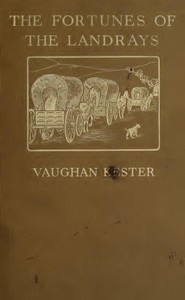
The Fortune of the Landrays — Context and Discussion
(0 User reviews)
638
Project Gutenberg
2016
Not confirmed
West (U.S.) -- Social life and customs -- Fiction; Families -- Fiction; Latter Day Saints -- Fiction
Readers of public-domain and historical texts
Project Gutenberg digital edition
en
Edition facts
Words
187,646
Reading time
816 min
Text sections
23
For The Fortune of the Landrays — Context and Discussion, the stored edition analysis reports 187,646 words, 13 hr 36 min estimated reading time, and 23 detected text sections.
The text analysis averages about 15.6 words per sentence, while the detected sections provide another way to judge how the source is divided.
Project Gutenberg metadata also associates the work with “West (U.S.) -- Social life and customs -- Fiction,” connecting these edition facts with the source record’s subject description.
Source:
Project Gutenberg record #52560
Vaughan Kester's 1905 novel follows Stephen Landray from a cramped stagecoach journey to a life shaped by family expectations and westward longing. The prose dwells on physical discomfort, suppressed ambition, and the weight of domestic duty, with dialogue and description revealing character through small, telling details.
Editorial Edition Score
4.9/5
★★★★★
★★★★★
Calculated from edition completeness, EPUB availability, text structure and catalogue metadata. Not a user rating.
How this score is calculated
- Description quality20 pts
- Title & short description10 pts
- Source metadata20 pts
- Text length15 pts
- Chapters / structure15 pts
- EPUB file integrity20 pts
Total of 100 points, scaled to a 2.5-5.0 range. Editions with an empty description or a missing EPUB file are not scored.
Edition quality
Read the Text
They had changed drivers so many times he had lost all count of them; and with the changing drivers a wearisome succession of passengers had come and gone; but to-day he and his father rode alone upon the box. That morning, the latter had told him they would reach Benson by noon, yet strangely enough his interest flagged; the miles seemed endless—interminable. He was sore and stiff; his little legs ached from their cramped position, and at last utterly weary he fell into a troubled sleep, his head resting on his father's arm, and his small hands, moist and warm, clasped idly in his lap.
His father, grim, motionless, and predisposed to silence, gave brief replies to such questions as Mr. Bartlett, the driver, saw fit to ask;—for Mr. Bartlett was frankly curious. As he said himself, he always liked to know who his passengers were, where they came from, where they were going, and if possible their business.
Now as they began the long descent of Landray's Hill, south of Benson, Mr. Bartlett pushed forward his brake handle and said, “That's Benson ahead of us, off yonder where you see the church spires; would you 'a knowed it, do you think?”
Instantly the man at his side who had been sitting low in his seat, took a more erect position, while a sudden light kindled in his dull eyes.
“Known it?” after a moment's survey of the scene before him. “Well, I guess not.” There was palpable regret in his tone, just touched by some hidden emotion; a passing shade of feeling not anticipated, that moved him.
“I allowed you wouldn't. Twenty years makes a heap of difference, don't it? Gives you a turn?” interestedly.
“Well, sort of,” with gentle sadness.
“I know how you feel. I been that way myself,” said the driver. Mr. Bartlett was short and stocky, with ruddy cheeks and great red hands. As one who mingled muck with the world, he prided himself on his social adaptability.
The stranger bestowed upon him a glance of frank displeasure. He felt vaguely that the other's sentiment was distasteful to him. It smacked of such fat complacency. At last he said, “I'd about made up my mind that I wa'n'. to see it again.” here a violent fit of coughing interrupted him. When it subsided, Mr. Bartlett remarked sympathetically:
“You ought to take something for that cough of your's. I would if it was mine.”
The stranger, still choking, shook his head.
“Where does it take you?”
“Here,” resting a bony hand on his sunken chest.
The stranger's jaws grew rigid. He favoured the driver with a sinister frown.
There was silence between them for a little space, which Mr. Bartlett devoted to a thoughtful study of his companion. Under this close scrutiny the stranger moved restlessly. A sense of the other's physical health oppressed him; it seemed to take from his own slender stock of vitality.
“Hope I ain't crowding you,” said Mr. Bartlett. “Here, I'll make more room for you. Well sir, Benson's about the healthiest place I know of. When a man gets ready to die there, he has to move away to do it.”
“Who the hell's talking about dying?” demanded the stranger savagely. “There are plenty of graveyards where I came from.”
“There are plenty of graveyards everywhere; yes sir, you'd have to do a heap of travelling to get shut of them.” admitted Mr. Bartlett impartially.
“And all the thundering fools ain't buried yet,” said the stranger shortly.
Mr. Bartlett meditated on this apparently irrelevant remark in silence. He had found the stranger taciturn and sullen, or given to flashes of grim humour.
“Where's Landray's mill?” the latter now demanded, the glint of anger slowly fading from his eyes.
“See that clump of willows down yonder, to the right of the road? It's just back of them.”
“Old General Landray's sons, Bush and Steve,” he spoke of them with easy familiarity.
“I see you know them,” said the stranger.
“It'd be funny if I didn't,—everybody knows 'em.”
“I reckon so,” said the stranger briefly.
“I allow you knowed the general?” remarked Mr. Bartlett.
“I recollect him well enough.”
“He was right smart of a man in his day, and one of the old original first settlers. I knowed him well myself,” observed Mr. Bartlett.
“Powerful easy man to get acquainted with; awful familiar, wa'n'. he?” and the stranger grinned evilly.
“Well, I knowed him when I seen him,” said Mr. Bartlett, with some reserve; and he seemed willing to abandon the subject. “What you laughing at?” he added quickly, for the stranger was chuckling softly to himself.
The novel opens with a boy on a stagecoach box, 'surfeited with travel,' his small legs aching and his attention dulled after days of watching 'miles upon miles of hot dusty road.' Kester builds the journey through cumulative, sensory detail—freight wagons, mounted traders, a drove of Marino sheep—before the boy falls asleep on his father's arm. This early passage establishes a pattern: physical discomfort and weary observation as entry points into character.
Later, Stephen Landray's interior life emerges through his reluctant study of law, a profession fixed upon him by his aunt Virginia. Kester renders Stephen's quiet anguish not through dramatic protest but through a 'dogged tenacity' that masks his true desire to go West. The prose tracks his secret misery in small, concrete images: 'digging away at his desk, among piles of papers, or delving into yellow calfskin volumes.'
Diction of Restraint and Repetition
Kester's diction favors understatement and repetition to convey emotional states. When Stephen learns of his mother's death, he repeats 'Dead?' and then asks 'When did it happen?'—the flatness of the dialogue mirrors his numbness. The narrator notes he was 'conscious of no emotion beyond surprise,' a phrase that refuses melodrama. Similarly, Stephen's aunt Virginia speaks 'very gently,' and her eyes are 'red as with weeping,' but the grief is held at a distance, filtered through the boy's limited comprehension.
This restraint extends to descriptions of the road: the 'same tiresome repetition of noisy towns and sleepy cross-road villages' and the 'narrow thread of yellow' road. Kester uses repetition not as filler but as a structural echo of Stephen's growing weariness. The cumulative effect is a world where feelings are implied rather than declared, and where the landscape itself becomes a measure of inner fatigue.
Voice Through Physical Sensation
Kester consistently anchors Stephen's perspective in bodily experience. The opening chapter dwells on 'sore and stiff' legs, 'cramped position,' and hands 'moist and warm' in sleep. This physicality persists into the law-school years: Stephen imagines himself 'returning dusty or muddy, according to the season' from circuit courts. The body registers what the character cannot articulate.
When Sam West delivers the summons home, Stephen's alarm is expressed through repeated questions—'What is it, Sam? You're sure she is not sick?'—and the narrator's report that he 'hurried into the library.' The physical urgency contrasts with the emotional blankness that follows the news. Kester uses this tension between bodily action and emotional numbness to define Stephen's voice: a young man who feels deeply but expresses little, whose body speaks for him.
Structure of Anticipation and Delay
The novel's structure, as glimpsed in the excerpts, builds around prolonged anticipation and delayed revelation. The stagecoach journey stretches across 'miles upon miles' and 'day after day,' with the destination—Benson—receding as Stephen's interest flags. This pattern recurs in Stephen's legal studies: he 'plodded grimly on' toward a future he dreads, the narrative lingering on his 'secret anguish' rather than advancing quickly to action.
The delivery of the mother's death is similarly delayed. Sam West's arrival, the walk home, the library scene—each step is drawn out. Virginia's 'manner was very gentle' and her eyes 'red as with weeping' prepare the reader before the news is spoken. Kester uses this structural patience to heighten the weight of ordinary moments, making the reader inhabit Stephen's own slow, reluctant movement toward knowledge.
Setting as Psychological Mirror
Kester's settings function less as backdrop than as extensions of Stephen's inner state. The road is 'hot dusty' and 'yellow,' the towns 'noisy' and 'sleepy,' all blending into a 'vivid panorama' that eventually fades into indifference. The law office in Stephen's imagination is 'stuffy' and filled with 'yellow calfskin volumes'—the color yellow recurs, linking the dust of travel to the dust of professional life.
Domestic spaces are equally telling. The library where Virginia waits is described only by its function, but the scene's emotional weight comes from its contrast with the open road Stephen longs for. The West exists as an imagined alternative, 'the only kind of life he could think of with any degree of satisfaction.' Kester never describes that West directly; it remains a counterpoint of possibility against the constrained interiors of Stephen's actual life.
Readers attentive to Kester's craft will notice how he builds character through what is withheld as much as what is shown. Stephen's desires are never spoken aloud; his grief is registered in pauses and repetitions. The novel rewards a slow reading that tracks these small signals—the ache in a child's legs, the color of a book's binding, the weight of a letter arriving at noon. Kester's restraint is not coldness but a deliberate choice to let the reader feel the pressure beneath the surface.
That rainy afternoon, the Landrays’ stifled longings hung in the air like the steam on my window. Flicking through my notes afterward, I stumbled on Margaret Oliphant’s quiet households—their inheritance was not land but expectation. Her prose felt less like a story than a murmured aside. By evening, the drizzle had softened into memory, and The Athelings; or, the Three Gifts. Vol. 1/3 — Reading Notes sat beside the kettle, patiently waiting its turn.
There are no reviews for this eBook.
There are no comments for this eBook.
Reader reflection
What was your reading experience?
Capture what you thought, learned, and would like to remember.
Your progress
0
/
10
2
How did the book work for you overall?
3
Would you recommend this book to another reader?
4
How much effort did this book require?
5
How clear did the writing feel?
6
Which element worked best for you?
7
How well did it match your expectations?
8
Did anything about the book feel genuinely new?
9
What did this book teach you most?
10