1

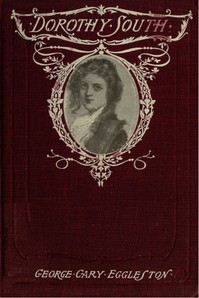
Dorothy South: A Love Story of Virginia Just Before the War — Text and Context
(0 User reviews)
2408
Project Gutenberg
2016
Not confirmed
Love stories; Virginia -- Fiction
Readers of public-domain and historical texts
Project Gutenberg digital edition
en
Edition facts
Words
98,077
Reading time
427 min
Text sections
10
This digital edition of Dorothy South: A Love Story of Virginia Just Before the War — Text and Context is described by source-level measurements including 98,077 words, 7 hr 7 min estimated reading time, and 10 detected text sections.
The text analysis averages about 18.9 words per sentence, while the detected sections provide another way to judge how the source is divided.
Project Gutenberg metadata also associates the work with “Love stories,” connecting these edition facts with the source record’s subject description.
Source:
Project Gutenberg record #52148
An editorial note examining the narrative voice and pacing in George Cary Eggleston's 1902 novel, focusing on the contrast between leisurely Virginia descriptions and urgent epistolary sections, and the rhetorical shifts in character dialogue.
Editorial Edition Score
4.9/5
★★★★★
★★★★★
Calculated from edition completeness, EPUB availability, text structure and catalogue metadata. Not a user rating.
How this score is calculated
- Description quality20 pts
- Title & short description10 pts
- Source metadata20 pts
- Text length15 pts
- Chapters / structure15 pts
- EPUB file integrity20 pts
Total of 100 points, scaled to a 2.5-5.0 range. Editions with an empty description or a missing EPUB file are not scored.
Edition quality
Read the Text
irement of the Virginia law that every gate set up across a public highway should be “easily opened by a man on horseback.”
Near the gate the young man slackened his vigorous pace and sat down upon a recently fallen tree. He remembered enough of his boyhood’s experience in Virginia to choose a green log instead of a dry one for his seat. He had had personal encounters with chigoes years ago, and wanted no more of them. He sat down not because he was tired, for he was not in the least so, but simply because, finding himself in the midst of a refreshingly and inspiringly beautiful scene, he desired to enjoy it for a space. Besides, he was in no hurry. Nobody was expecting him, and he knew that dinner would not be served whither he was going until the hour of four--and it was now only a little past nine.
The young man was fair to look upon. A trifle above the medium height, his person was symmetrical and his finely formed head was carried with an ease and grace that suggested the reserve strength of a young bull. His features were about equally marked by vigor and refinement. His was the countenance of a man well bred, who, to his inheritance of good breeding had added education and such culture as books, and earnest thinking, and a favorable association with men of intellect are apt to bring to one worthy to receive the gift.
He seemed to know the spot wherein he lingered. Indeed he had asked no questions as to his way when less than an hour ago he had alighted from the pottering train at the village known as the Court House. He had said to the old station agent, “I will send for my baggage later.” Then he had set off at a brisk walk down one of the many roads that converged at this centre of county life and affairs. The old station master, looking after him, had muttered: “He seems to think he knows his way. Mebbe he does, but anyhow he’s a stranger in these parts.”
And indeed that would have been the instant conclusion of any one who should have looked at him as he sat there by the roadside enjoying the sweet freshness of the morning, and the exquisite abandon with which exuberant nature seemed to mock at the little track made through the tangled woodlands by intrusive man. The youth’s garb betrayed him instantly. In a country where black broadcloth was then the universal wear of gentlemen, our young gentleman was clad in loosely fitting but perfectly shaped white flannels, the trousers slightly turned up to avoid the soil of travel, the short sack coat thrown open, and the full bosomed shirt front of bishop’s lawn or some other such sheer stuff, being completely without a covering of vest. Obviously the young pedestrian did not belong to that part of the world which he seemed to be so greatly enjoying.
That is what Dick thought, when Dick rode up to the gate. Dick was a negro boy of fourteen summers or about that. His face was a bright, intelligent one, and he looked a good deal of the coming athlete as he sat barebacked upon the large roan that served him for steed. Dick wore a shirt and trousers, and nothing else, except a dilapidated straw hat which imperfectly covered his closely cropped wool. His feet were bare, but the young man made mental note of the fact that they bore the appearance of feet accustomed to be washed at least once in every twenty four hours.
“Does your mammy make you wash your feet every night, or do you do it of your own accord?” The question was the young man’s rather informal beginning of a conversation.
“Mammy makes me,” answered the boy, with a look of resentment in his face. “Mammy’s crazy about washin’. She makes me git inter a bar’l o’ suds ev’ry night an’ scrub myself like I was a floor. That’s cause she’s de head washerwoman at Wyanoke. She’s got washin’ on de brain.”
“So you’re one of the Wyanoke people, are you? Whom do you belong to now?”
“I don’t jes’ rightly know, Mahstah”--Dick sounded his a’s like “aw” in “claw.” “I don’t jes’ rightly know, Mahstah. Ole Mas’r he’s done daid, an’ de folks sez a young Yankee mahstah is a comin’ to take position.”
“To take possession, you mean, don’t you?”
“I dunno. Somefin o’ dat sort.”
“Why do you call him a Yankee master?”
From its opening sentence, which invokes Lowell's 'a day in June' and immediately pivots to the 'incomparable climate of south side Virginia,' George Cary Eggleston's Dorothy South establishes a narrator who is both literary and locally rooted. The prose moves with a deliberate, almost unhurried rhythm, lingering on the 'luxuriantly growing woodland' and the 'orchestra of bird performers' before introducing the young man walking 'with vigor down the narrow roadway.' This early contrast between static description and purposeful motion sets a pattern: the novel alternates between expansive, sensory-rich passages and moments of compressed action or dialogue.
The Rhetoric of Persuasion
The excerpt from a letter (likely Chapter XXXV or later) reveals a shift in narrative pace through direct address and rhetorical questions. The speaker—possibly Arthur Brent or another character—employs a cascade of interrogatives: 'Did you ever know a better mind than hers? Was there ever a whiter soul?' The repetition of 'Is not her courage admirable? Is not her truthfulness...' creates a rhythmic insistence that contrasts with the earlier descriptive languor. This section also introduces a philosophical argument about happiness and productivity, citing Shakespeare, Beethoven, Washington, and Jefferson. The tone is urgent, almost hectoring, as the speaker accuses the listener of 'a strange dislike of happiness.' The pace here is driven by persuasion, not plot.
Paternal Edict and Narrative Compression
A second key passage compresses years of backstory into a few paragraphs, summarizing Dr. South's 'morbidly anxious' plans for his daughter. The narrator reports that Dr. South 'decreed that she should learn nothing of music, or art or any other thing which he believed would prove a temptation.' The language is economical, almost clinical: 'He had no conception of her character, her genius or her capacities.' This summary contrasts sharply with the novel's earlier scenic mode. The betrothal to Jefferson Peyton is presented as a 'bargain' between two men, with the narrator's judgment—'arrogant, silly young donkey'—inserted parenthetically. The pace accelerates through summary, covering years in a single paragraph.
Voice and the Shifting Center
The novel's narrative voice is not uniform. The opening chapter adopts a third-person omniscient perspective that occasionally addresses the reader directly ('It was a perfect day of the kind that Mr. Lowell has celebrated in song'). Later sections, particularly the letter, shift to a first-person voice that is passionate and argumentative. This change in narrative distance affects pacing: the omniscient narrator observes and describes, while the letter writer cajoles and reproaches. The contrast is heightened by the letter's use of exclamation points and dashes, creating a breathless, intimate tone. Eggleston thus modulates pace not only through scene versus summary but through shifts in who is speaking and how directly they address the reader or listener.
Readers attentive to narrative technique will find in Dorothy South a study in contrasts: between the static beauty of the Virginia landscape and the dynamic forces of persuasion, between paternal decree and individual awakening. The novel's pacing is not uniform; it accelerates through summary and decelerates through scenic description and rhetorical elaboration. Pay attention to who controls the narrative voice at any given moment—the omniscient observer, the letter writer, or the characters in dialogue—as this often signals a shift in emotional intensity and narrative speed.
There’s something about how Eggleston lets the slow Virginia air stretch out, then suddenly tightens it with those urgent letters—it stayed with me long after. That same quiet tension between waiting and moving lives in The Trufflers: A Story — Key Ideas to Explore, lingering like an unfinished thought I keep returning to, almost gently.
There are no reviews for this eBook.
There are no comments for this eBook.
Reader reflection
Record your reading impressions
A brief reflection can help important ideas stay with you longer.
Your progress
0
/
10
2
How much did you enjoy the reading experience?
3
Is this a title you would suggest to others?
4
How easy was the book to follow?
5
How valuable was this book for your own interests?
6
Could you follow the author’s main argument?
7
How strong was your personal connection to the text?
8
Was the book what you thought it would be?
9
What is the main idea you are taking away?
10