1

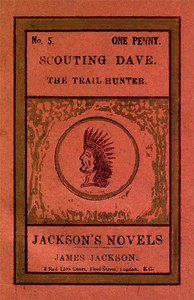
Scouting Dave: The Trail Hunter — A Closer Reading
(0 User reviews)
1556
Project Gutenberg
2015
Not confirmed
Dime novels; Black Hawk War, 1832 -- Fiction
Readers of public-domain and historical texts
Project Gutenberg digital edition
en
Edition facts
Words
25,970
Reading time
113 min
Text sections
13
This digital edition of Scouting Dave: The Trail Hunter — A Closer Reading is described by source-level measurements including 25,970 words, 1 hr 53 min estimated reading time, and 13 detected text sections.
The text analysis averages about 17.5 words per sentence, while the detected sections provide another way to judge how the source is divided.
Project Gutenberg metadata also associates the work with “Dime novels,” connecting these edition facts with the source record’s subject description.
Source:
Project Gutenberg record #49785
This editorial note examines how James L. Bowen's dime novel 'Scouting Dave: The Trail Hunter' uses catalog subjects like the Black Hawk War and dime novel conventions, focusing on the tension between historical framing and formulaic adventure tropes in the excerpts.
Editorial Edition Score
4.7/5
★★★★★
★★★★★
Calculated from edition completeness, EPUB availability, text structure and catalogue metadata. Not a user rating.
How this score is calculated
- Description quality20 pts
- Title & short description10 pts
- Source metadata20 pts
- Text length15 pts
- Chapters / structure15 pts
- EPUB file integrity20 pts
Total of 100 points, scaled to a 2.5-5.0 range. Editions with an empty description or a missing EPUB file are not scored.
Edition quality
Read the Text
The scene opens in the Far West. In the forest the evening’s gloom already was settling, though here and there, through some narrow vista, a rich ray of sunlight poured its golden flood far into the shadowy depths. The place was lonely and drear, yet wild and grand. Approaching civilization had driven out the red-man, while his place had not, as yet, been filled by the spreading white. Deep silence reigned, disturbed only by the myriad sounds of animal and insect life, called forth by the rare beauties of the evening. The sights and sounds of civilization were not there; and yet, we should, perhaps, make a single exception.
Stealing cautiously along, with a tread as light as that of a shade, was one of that famed and daring class, met nowhere save on the advance of American settlements—the border scouts, who, born to danger and inured to hardship, become, as a race, the very embodiment of bravery, endurance, strategy and recklessness. These are the ruling characteristics of the class, though as varied in individuals as are the personalities of “citizens of the world.”
The person to whom we have referred was a worthy specimen of his class. Tall, erect and graceful in every motion, with eyes and ears from which not the slightest sign or sound could escape, David Barring, or “Davy the Scout,” as he was often called, was fitted, both by nature and education, for the rough life which he was called upon to lead. Though taller than the average of men, his compact frame and symmetrical proportions served, in a great measure, to disguise his real height.
His dress was in keeping with his life and habits. Bearskin cap, deerskin leggins, and Indian moccasins, in addition to the ordinary hunting suit, tended to enhance the wild character of his person.
There was little necessity for the extreme caution which David still continued to exercise. It sprung more from habit and long practice than from any present danger. That the scout was deeply agitated, might readily be gathered from the manner in which he mused, half aloud, as he proceeded:
“Four years, since I’ve travelled through this place. But it’s bad news I bring ’em this time, so it is. Wouldn’t blame ’em if they didn’t believe me, not a bit; but ’twould be bad times for ’em if they shouldn’t. Them as knows Davy Barring won’t doubt his word in Injin matters, not by a long shot. Wonder, though, how the settlers will like the idee o’ runnin’ away from these four tribes of heathens, with old Black Hawk and all his crew yellin’ round their ears? Blame me if I don’t wish there were a hundred or two men jis’ like myself, to rally here and give ’em a warmin’! Wouldn’t there be a skittish time, though? But there isn’t; so we may as well take things as they come. Maybe, arter all, the reds will strike another way, and give these folks a chance to take the back track. But it does come hard to give up all a man’s done for six or ten years, and leave it to such ornery villains. It’s a consolation there isn’t as many o’ the redskins as there would have been if Davy Barring hadn’t been born; and it’s sure there’ll be less yet, if nothin’ happens to Mister Davy, and his old rifle don’t miss fire.”
The scout spoke with an air which showed his sincerity and determination. Indeed, the mission upon which he was engaged was one of no ordinary moment. Scouting upon the western shore of the Mississippi, then unsettled by white men, he had learned the intent of the savages, who, under Black Hawk, their renowned chief, had determined to repossess themselves on the soil from which they had been driven. Justly concerned for the fate of his friends, David at once had set out to warn them.
“I wonder how the Hinton family will receive this news?” he mused, as he stole along. “It may be they have moved away, though I presume not. However, it’s not more’n five miles further to their cabin, and then I can satisfy myself. Pretty Emily Hinton! A sweeter girl than she never crossed the path of a mortal man. If I ever hoped to wed, there’s no other woman I ever saw that would take my fancy like her. But that can’t be. I never could give up this kind o’ life, and it’s no life for a woman to share. I always hoped that Charles Markley and Emily would come together. But that is none of my business.”
The opening chapter of Scouting Dave: The Trail Hunter introduces David Barring, a border scout, in a forest described as 'lonely and drear, yet wild and grand.' The narrative voice immediately establishes a contrast between the departing red-man and the not-yet-arrived white settler, framing the scout as a transitional figure. The catalog subjects list this as a Black Hawk War (1832) fiction, but the excerpts show little direct engagement with that conflict; instead, the story leans on generic frontier peril—'four tribes of heathens, with old Black Hawk and all his crew'—as a backdrop for personal drama.
The Scout as Type, Not Individual
David Barring is introduced less as a distinct character and more as a specimen of a class: 'the very embodiment of bravery, endurance, strategy and recklessness.' His physical description—'tall, erect and graceful'—and his dress of bearskin cap and deerskin leggins match dime novel conventions rather than historical specificity. The narrative even notes that his caution 'sprung more from habit and long practice than from any present danger,' emphasizing the performative nature of his scouting identity. The excerpts do not reveal any unique backstory or personal motivation beyond warning settlers, making him a functional hero rather than a psychologically developed figure.
Captivity and Sentimental Melodrama
The later excerpt shifts to Emily, a captive, whose interiority is rendered in heightened sentimental language: 'the bitterest anguish surging over her soul like a destroying flood.' Her grief over her father's death and her anxiety for a loved one follow the captivity narrative formula common in dime novels. Notably, the Indian character Red Wing shows a 'touch of kindness' and unbinds her, a trope of the 'noble savage' that complicates the otherwise hostile portrayal of Native Americans. The scene relies on emotional appeal rather than historical accuracy, with Emily's suffering serving to heighten the stakes for the absent hero.
Historical Setting as Loose Frame
Despite the catalog subject 'Black Hawk War, 1832 — Fiction,' the excerpts use the war primarily as a vague threat. Black Hawk is mentioned only once, in Dave's musing about 'old Black Hawk and all his crew,' and no specific battles, dates, or locations are given. The setting is a generic 'Far West' forest, with no markers of the actual Upper Mississippi River Valley where the war occurred. This suggests the war functions as a convenient backdrop for adventure rather than a historically grounded plot. The dime novel format prioritizes action and sentiment over fidelity to events, a pattern consistent with the genre's commercial aims.
Readers approaching Scouting Dave: The Trail Hunter should expect a formulaic frontier adventure that uses the Black Hawk War as a loose setting for captivity and rescue tropes. The excerpts reveal a tension between the catalog's historical claim and the text's generic conventions. Pay attention to how the narrative balances Dave's competent scout persona with Emily's sentimental ordeal—this dual focus is key to the dime novel's appeal.
I keep thinking about how that old dime novel held history so lightly, letting adventure blur the edges of what really happened. It reminded me of another book I sat with quietly, one where the weight of belief feels just as strange and personal. The White Prophet, Volume 1 (of 2) — Inside the Classic lingered with me the same way—less a story than a mood you don't shake off.
There are no reviews for this eBook.
There are no comments for this eBook.
Reader reflection
Before you leave, reflect on the book
Use these questions to collect your thoughts before moving on.
Your progress
0
/
10
2
Did this book hold your interest?
3
How likely are you to recommend this book?
4
How easy was the book to follow?
5
Could you apply anything you learned?
6
How did the reading compare with what you expected?
7
Did any part of the book stay with you emotionally?
8
Did you relate to its people, ideas, or situations?
9
Which lesson or insight stayed with you?
10