1

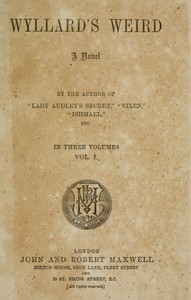
Wyllard's Weird: A Novel — Edition Insights
(0 User reviews)
663
Project Gutenberg
2015
Not confirmed
Murder -- Fiction; Mystery and detective stories
Readers of public-domain and historical texts
Project Gutenberg digital edition
en
Edition facts
Words
173,890
Reading time
757 min
Text sections
15
Before opening Wyllard's Weird: A Novel — Edition Insights, the edition data offers a quick orientation: 173,890 words, 12 hr 37 min estimated reading time, and 15 detected text sections.
The text analysis averages about 18.1 words per sentence, while the detected sections provide another way to judge how the source is divided.
Project Gutenberg metadata also associates the work with “Murder -- Fiction,” connecting these edition facts with the source record’s subject description.
Source:
Project Gutenberg record #50037
An editorial note examining M. E. Braddon's diction, dialogue, and descriptive choices in this 1885 mystery novel, focusing on the opening Cornish setting, the detective's methodical observations, and the subtle use of resemblance as a plot device.
Editorial Edition Score
4.8/5
★★★★★
★★★★★
Calculated from edition completeness, EPUB availability, text structure and catalogue metadata. Not a user rating.
How this score is calculated
- Description quality20 pts
- Title & short description10 pts
- Source metadata20 pts
- Text length15 pts
- Chapters / structure15 pts
- EPUB file integrity20 pts
Total of 100 points, scaled to a 2.5-5.0 range. Editions with an empty description or a missing EPUB file are not scored.
Edition quality
Read the Text
There are some travellers who think when they cross the Tamar, over that fairy bridge of Brunel's, hung aloft between the blue of the river and the blue of the sky, that they have left England behind them on the eastern shore--that they have entered a new country, almost a new world. This land of quiet woods and lonely valleys, and bold brown hills, barren, solitary--these wild commons and large moorlands of Cornwall seem to stand apart, as they did in the days gone by, when this province was verily a kingdom, complete in itself, and owning no sovereignty but its own.
It is a beautiful region which the traveller sees, perchance for the first time, as the train skims athwart the quaint little waterside village of Saltash, and pierces the rich depths of the woodland, various, enchanting. Now the line seems strung like a thread of iron in mid-air above a deep gorge, now winds sinuous as a snake through a labyrinth of hills. A picturesque bit of road, this between Plymouth and Bodmin Road, at all times; but, perhaps, loveliest in the still evening hour, when the summer sunset steeps the land in golden light, while the summer wind scarcely stirs the woods.
In the mellow light of a July eventide the express from Paddington swept with slackened speed round the curve which marked the approach to a viaduct between Saltash and Bodmin Road--a heavy wooden structure, spanning a vale of Alpine beauty. An exquisite little bit of scenery, upon which the stranger is apt to look with some touch of fear mingled in the cup of his delight: but to the dweller in the district, familiar with every yard of the journey, the transit is as nothing. He is carried through the air serenely, as he smokes his cigar and reads his paper, and the notion of peril never occurs to him.
One man, sitting by the window of a third-class carriage near the end of the train, looked out at the familiar scene dreamily to-night. He was an elderly, gray-headed man, a parish doctor, hard-worked and poorly paid; but he had a keen eye for the beautiful in Nature, dead or living, and familiar as this spot was to his eye, it always impressed him. He sat with his face to the engine, puffing lazily at his black briarwood, and gazing at the landscape, in that not unpleasant condition of bodily and mental fatigue, when the mind seems half asleep, and the external world is little more than a dream-picture.
The train was not a long one, a good many of the London coaches having been left behind at Plymouth. Dr. Menheniot put out his head, and surveyed the line of carriages as they rounded the curve. There was a figure here and there by a window; but the train seemed sparsely occupied. They were nearing the viaduct. That narrow thread of water trickling over its rocky bed in the depth of the gorge was in winter a rushing torrent. The line at this point was under repair, and the wooden palisade had been removed in the progress of the work. The actual danger was in nowise increased by the absence of this barrier, which would have crumbled like matchwood before the weight of the train, had the engine run off the rails--but there was a seeming insecurity to the eye of the traveller as he looked into the gulf below; and Dr. Menheniot gave an involuntary shudder. Another moment and the engine came on the viaduct. Menheniot started up with a half-articulate exclamation, "What, in God's name--" he began.
He opened the carriage-door, seemed as if he were going to clamber out, to try and make his way along the footboard to a distant carriage, outside which a girl was standing, holding on to the brass hand-rail at the side of the door. She had that instant stepped out, or been thrust out; Menheniot knew not which. He had seen nothing till he saw her standing there, a slender figure in a light-coloured gown, thin draperies fluttering in the wind--standing there, hanging between life and death, a creature to be rescued somehow, were it at the hazard of a man's life.
Before he could put himself in peril the chance of rescue was over. A wild shriek rang through the wood--a fluttering form went whirling down the ravine, flashing white athwart the sunlit greenery, and lay half buried amidst a tangle of ferns and wild flowers at the bottom of the gorge.
Braddon opens Wyllard's Weird with a leisurely, almost painterly description of a Cornish railway journey, contrasting the traveller's awe with the local's indifference. The prose lingers on the viaduct's 'Alpine beauty' and the 'mellow light of a July eventide,' establishing a landscape that feels both idyllic and isolated. This careful attention to setting is not mere scene-painting; it grounds the mystery in a specific, tangible world where the familiar can suddenly become strange.
Diction and the Doctor's Gaze
The narrative voice often aligns with Dr. Edward Heathcote, the parish doctor who first observes the landscape 'dreamily' while smoking his briarwood pipe. Braddon uses his professional, observant tone to filter details: he has a 'keen eye for the beautiful in Nature, dead or living,' a phrasing that subtly foreshadows his later role as an investigator of both natural and unnatural deaths. His mental fatigue is described as a state where 'the mind seems half asleep, and the external world is little more than a dream-picture'—a condition that makes his sudden, sharp realizations all the more striking. The author avoids melodramatic language in these passages, preferring a measured, almost clinical precision that lends credibility to the detective work.
Dialogue and the Weight of Silence
Conversations in the excerpts are marked by what is left unsaid. When Heathcote reveals the likeness between the photograph of Marie Prévol and Mrs. Wyllard, Julian Wyllard responds 'coldly,' passing the photograph back without elaboration. The dialogue is terse, with characters often deflecting or mocking: Wyllard's remark about Saint-Germain gaining 'an additional charm' from a double murder is a barbed, ironic comment that reveals his discomfort. Braddon uses such exchanges to build tension without explicit exposition, letting the reader infer the undercurrents of suspicion and withheld knowledge.
Structure and the Slow Unfolding of Clues
The narrative structure in these early chapters is deliberately unhurried. The first chapter, 'In a Cornish Valley,' devotes several paragraphs to the landscape before introducing any character or incident. This pacing mirrors the methodical approach of the detective: Heathcote's investigation proceeds through careful observation and incremental revelation. The chapter titles themselves—'After the Inquest,' 'Joseph Distin,' 'Bothwell Declines to Answer'—suggest a series of discrete scenes rather than a continuous, breathless plot. Braddon trusts the reader to piece together connections, such as the significance of the cabman's evidence showing Léonie 'on the best possible terms' with her companion, a detail that complicates the initial suspicion of murder.
Recurring Motifs: Likeness and Recognition
A central device in the excerpts is the motif of resemblance. Heathcote is 'perplexed—worried, even—by a sense of familiarity' in the photograph of the dead Marie Prévol; later, he realizes the likeness is to Mrs. Wyllard, though it is 'not an obvious or striking likeness' but one 'rather in expression than in feature.' This subtle, almost uncanny connection between the living and the dead becomes a thread that ties together disparate characters. Braddon uses the idea of recognition—both mistaken and accurate—to drive the plot, as when Léonie is said to have 'recognised the murderer of her aunt,' a claim immediately undercut by contradictory evidence. The author plays with the reliability of visual memory, suggesting that faces can deceive as easily as words.
Readers approaching Wyllard's Weird should attend to Braddon's deliberate pacing and her use of the mundane—a train journey, a photograph, a casual remark—as the foundation for mystery. The novel rewards patience, as clues are embedded in descriptive passages and offhand dialogue rather than in dramatic revelations. The Cornish setting is not merely picturesque but integral to the atmosphere of isolation and hidden knowledge. This is a detective story that values atmosphere and character as much as plot.
That rainy afternoon, I kept turning back to how M. E. Braddon lets resemblance linger without explaining it—a quiet, unsettling thread. It made me think of water moving beneath ice, and somehow I found myself holding Dividing Waters — Story, Setting & Ideas, which traces that same submerged pull between people and place. The storm passed, but that current stayed with me.
There are no reviews for this eBook.
There are no comments for this eBook.
Reader reflection
Take a moment to reflect on this book
Create a short personal record of your experience with this book.
Your progress
0
/
10
2
Was reading this book enjoyable?
3
Is this a title you would suggest to others?
4
How easy was the book to follow?
5
Would you start a conversation about this book?
6
Which aspect of the book did you value most?
7
Was the book easy to understand?
8
Do you expect to return to this book?
9
What did this book teach you most?
10