1

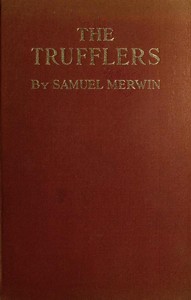
The Trufflers: A Story — Key Ideas to Explore
(0 User reviews)
425
Project Gutenberg
2016
Not confirmed
Dramatists -- Fiction; Man-woman relationships -- Fiction; Greenwich Village (New York, N.Y.) -- Fiction
Readers of public-domain and historical texts
Project Gutenberg digital edition
en
Edition facts
Words
90,762
Reading time
395 min
Text sections
12
This digital edition of The Trufflers: A Story — Key Ideas to Explore is described by source-level measurements including 90,762 words, 6 hr 35 min estimated reading time, and 12 detected text sections.
The text analysis averages about 11.7 words per sentence, while the detected sections provide another way to judge how the source is divided.
Project Gutenberg metadata also associates the work with “Dramatists -- Fiction,” connecting these edition facts with the source record’s subject description.
Source:
Project Gutenberg record #51985
Samuel Merwin's 1916 novel follows playwright Peter Ericson Mann and his Greenwich Village circle, using shifting scenes and recurring motifs of artistic struggle, romantic entanglement, and the tension between bohemian ideals and practical realities.
Editorial Edition Score
4.9/5
★★★★★
★★★★★
Calculated from edition completeness, EPUB availability, text structure and catalogue metadata. Not a user rating.
How this score is calculated
- Description quality20 pts
- Title & short description10 pts
- Source metadata20 pts
- Text length15 pts
- Chapters / structure15 pts
- EPUB file integrity20 pts
Total of 100 points, scaled to a 2.5-5.0 range. Editions with an empty description or a missing EPUB file are not scored.
Edition quality
Read the Text
Peter was a playwright of three early (and partial) successes, and two more recent failures. He was thirty-three years old; and a typical New Yorker, born in Iowa, he dressed conspicuously, well, making it a principle when in funds to stock up against lean seasons to come. He worried a good deal and kept his savings of nearly six thousand dollars (to the existence of which sum he never by any chance alluded) in five different savings banks. He wore large horn-rimmed eyeglasses (not spectacles) with a heavy black ribbon attached, and took his Art almost as seriously as himself. You know him publicly as Eric Mann.
For six months Peter had been writing words where ideas were imperatively demanded. Lately he had torn up the last of these words. He had waited in vain for the divine uprush; there had come no tingle of delighted nerves, no humming vitality, no punch. And as for his big scene, in Act III, it was a morass of sodden, tangled, dramatic concepts.
His theme this year was the modern bachelor girl; but to save his life he couldn't present her convincingly as a character in a play--perhaps because these advanced, outspoken young women irritated him too deeply to permit of close observation. Really, they frightened him. He believed in marriage, the old-fashioned woman, the home.
It had reached the point, a month back, where he could no longer even react to stimulants. He had revived an old affair with a pretty manicure girl without stirring so much as a flutter of excitement within himself. This was Maria Tonifetti, of the sanitary barber shop of Marius in the basement of the Parisian Restaurant. He had tried getting drunk; which made him ill and induced new depths of melancholy.
No one ever saw his name any more. No one, he felt certain, ever would see it. He could look back now on the few years of his success in a spirit of awful calm. He felt that he had had genius. But the genius had burned out. All that remained to him was to live for a year or two (or three) watching that total of nearly six thousand dollars shrink---shrink---and then the end of everything. Well, he would not be the first....
One faint faded joy had lately been left to Peter, one sorry reminder of the days when the magical words, the strangely hypnotic words, “Eric Mann,” had spoken, sung, shouted from half the bill-boards in town. Over beyond Sixth Avenue, hardly five minutes' walk through the odd tangle of wandering streets, the tenements and ancient landmarks and subway excavations and little triangular breathing places that make up the Greenwich Village of to-day, there had lingered one faded, torn twenty-four-sheet poster, advertising “The Buzzard, by Eric Mann.”
When he was bluest lately, Peter had occasionally walked over there and stood for a while gazing at this lingering vestige of his name.
He went over there now, in soft hat and light overcoat, and carrying his heavy cane--hurried over there, in fact--across the Square and on under the Sixth Avenue elevated into that quaint section of the great city which socialists, anarchists, feminists, Freudian psycho-analysts of self, magazine writers, Jewish intellectuals, sculptors and painters of all nationalities and grades, sex hygiene enthusiasts, theatrical press-agents and various sorts of youthful experimenters in living share with the merely poor.
He stopped at a familiar spot on the curb by a familiar battered lamp-post and peered across the street.
Then he started--and stared. Surprise ran into bewilderment, bewilderment into utter dejection.
The faded, torn twenty-four-sheet poster had vanished.
A new brand of cut plug tobacco was advertised there now.
Ragged children of the merely poor, cluttering pavement and sidewalk, fell against him in their play. Irritably he brushed them aside.
It was indeed the end.
A young woman was crossing the street toward him, nimbly dodging behind a push cart and in front of a coal truck. Deep in self, he lowered his gaze and watched her. So intent was his stare that the girl stopped short, one foot on the curb, slowly lowered the apple she was eating, and looked straight at him.
She was shaped like a boy, he decided--good shoulders, no hips, fine hands (she wore no gloves, though the March air was crisp) and trim feet in small, fiat-heeled tan boots. Her hair, he thought, was cut short. He was not certain, for her “artistic” tarn o'shanter covered it and hung low on her neck behind. He moved a step to one side and looked more closely. Yes, it was short. Not docked, in the current fashion, but cut close to her head, like a boy's.
The novel opens with Peter Ericson Mann, a playwright in his early thirties, staring out at Washington Square from a dingy studio. He has just abandoned a third act. This image—a stalled writer at a window—recurs throughout the book, anchoring the narrative in Peter's creative paralysis. The story moves between studios, restaurants, and the streets of Greenwich Village, tracking a group of artists and hangers-on who call themselves the Trufflers. Merwin builds the novel around a series of encounters, letters, and telephone calls that propel the plot forward, often with a sharp, ironic tone.
Windows and Watchers
The opening chapter establishes a pattern: Peter peers out at the park, then returns to his typewriter. This gesture repeats in later scenes, as characters look out at the city or at each other. The Worm, a cynical observer, is often described watching others from his desk. The telephone becomes a device for missed connections and eavesdropping, as when the Worm intercepts a call meant for Hy and lies about his whereabouts. These recurring details—windows, telephones, doorways—create a sense of characters perpetually on the verge of action but often held back by hesitation or circumstance.
The Gift and the Grind
Merwin contrasts two approaches to success: Hy Lowe, a ladies' man who claims his charm is a gift, and Peter, who labors over his writing. In a conversation, Hy boasts about his romantic conquests, while the Worm dryly notes that Hy's “defense” accounts for only three months of his life. Peter, meanwhile, has torn up months of work and waits for inspiration. The novel does not resolve which path is superior; instead, it presents both as flawed. The Worm's remark that Hy's success is “a gift—perhaps plus eyelashes” undercuts the idea of pure talent, suggesting that luck and appearance play a role.
Letters and Leaps
Letters drive the plot. Hy carries a long letter from a woman he calls a “pagan woman,” reading it aloud to the Worm. The Worm warns him not to share it. Later, a telephone call from a woman named Betty Deane—Hy's former flame—sends him fleeing. These episodes show how written and spoken words trigger action or flight. The novel's chapter titles, such as “Peter Gets a Note” and “The Buzzer,” emphasize the importance of messages. Yet the content of these messages is often withheld from the reader, creating gaps that force us to infer motives and outcomes.
Movement Between Scenes
The story jumps between locations: Peter's studio, the Worm's office, a restaurant called Jim's, and the streets of Greenwich Village. Chapter titles like “Fifty Minutes from Broadway” and “At the Corner of Tenth” signal a geography that is both specific and symbolic. Characters move quickly—Hy runs down stairs instead of waiting for an elevator, Peter walks to the window and back. These movements mirror the restless energy of the Trufflers, who are always seeking something: a new play, a new romance, a new escape. The novel's structure, with its short chapters and abrupt transitions, reinforces this sense of constant motion.
Readers should pay attention to the gaps in the narrative—the letters we never see, the phone calls we only hear one side of. Merwin uses these omissions to create suspense and to suggest that what is left unsaid matters as much as what is spoken. The Trufflers is a story about people who talk a great deal but often fail to communicate, and whose grand plans rarely survive contact with reality.
The Trufflers stayed with me long after the rain stopped. Its bohemians chased art and each other, forever tangled in what felt noble versus what proved possible. That slump I felt, that fog, eventually led me to The Raft — Context and Discussion, where a similar question floats on open water. Odd, how one story’s restlessness can find its quiet echo elsewhere.
There are no reviews for this eBook.
There are no comments for this eBook.
Reader reflection
How did this book work for you?
Your answers remain private and are stored only in this browser.
Your progress
0
/
10
2
Was reading this book enjoyable?
3
Is this a title you would suggest to others?
4
How much effort did this book require?
5
What was its emotional impact?
6
Did anything about the book feel genuinely new?
7
Did the book deliver what you hoped for?
8
Did any part of the book feel personally relevant?
9
What is the main idea you are taking away?
10