1

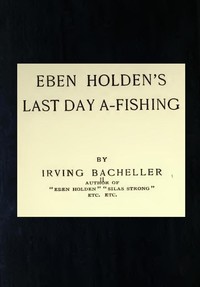
Eben Holden's Last Day A-Fishing — Text and Context
(0 User reviews)
37
Project Gutenberg
2016
Not confirmed
Farm life -- Fiction; New York (State) -- Fiction
Readers of public-domain and historical texts
Project Gutenberg digital edition
en
Edition facts
Words
11,383
Reading time
50 min
Text sections
3
The catalog record for Eben Holden's Last Day A-Fishing — Text and Context provides practical reading context through 11,383 words, 50 min estimated reading time, and 3 detected text sections.
The text analysis averages about 17.9 words per sentence, while the detected sections provide another way to judge how the source is divided.
Project Gutenberg metadata also associates the work with “Farm life -- Fiction,” connecting these edition facts with the source record’s subject description.
Source:
Project Gutenberg record #52454
Irving Bacheller's sketch of an elderly man's final fishing trip blends pastoral observation with a narrator's reflections on memory, ownership, and the passage of time, conveyed through a voice that shifts between colloquial dialogue and lyrical description.
Editorial Edition Score
4.5/5
★★★★★
★★★★★
Calculated from edition completeness, EPUB availability, text structure and catalogue metadata. Not a user rating.
How this score is calculated
- Description quality20 pts
- Title & short description10 pts
- Source metadata20 pts
- Text length15 pts
- Chapters / structure15 pts
- EPUB file integrity20 pts
Total of 100 points, scaled to a 2.5-5.0 range. Editions with an empty description or a missing EPUB file are not scored.
Edition quality
Read the Text
he midst of the days that are few and silent—those adorned with the fading flowers of old happiness and thoughts which are “the conclusion of the whole matter.” As for ourselves, we found them full of a peace and charm I would fain impart to those who read of them, if that
were possible. I know well how feebly I shall do my task, but now, at last, a time is come when it seems to call me, and I can begin it with some hope and courage. I shall try not to write a book, nor a tale even, but mainly to gather a few flowers, now full grown, in the garden of remembrance. You that see it growing lovelier in the lengthening distance will understand me.
Always, when our train went roaring into the quiet village, we used to look out of the car-window down across the river and a smooth stretch of fields into the edge of the little town. At a small, familiar opening in the shade-trees, almost half a mile from the train, we never failed to see the flicker of a white handkerchief. It signalled their welcome. And then—well, I doubt
if any one may have in this world better moment. Yes—that was years ago, and there are strangers in the old home, but to this day every time I enter Hillsborough I look for that flicker of white, away off among the trees.
That day the signal greeted us, and was only one of many joys, for it was a day of a thousand, warm, and full of the music of birds and of bees' wings and the odor of new blossoms and a great happiness. Elizabeth Brower stood at the gate, and beyond her we could see Uncle Eb on the veranda, sitting in his arm-chair. The dear woman put her fingers on her lips, and we knew what it meant. Uncle Eb had fallen asleep in the warm sunlight. We greeted her with hushed voices, and approached the venerable man, and sat down at his feet, smiling
and looking up at his fine old face. He continued to sleep, all unconscious that we were near him. Soon we heard him call in his dreams, just above a whisper: “Here Fred! here Fred!” It was the name of our old dog, dead these many years. His nap must have taken him far back—perhaps into that long, westward journey through woods and fields. I took his hand in mine. He came out of his dreams with a start, and looked up at me.
“What!” said he. “Wal, I declare.”
He rose and clung to our hands and looked into our faces with a full heart.
“A merry birthday!” I exclaimed.
“See here, Bill Brower,” said he. “You've hearn o' the joy o' Paradise?”
“Wal, here's the key-note o' the song,” said Uncle Eb. “Now look here, Liz Brower,” he went on, “you tell 'Sindy we got to have the best dinner ever made by human hands. I'll bring some water.”
Elizabeth, Uncle Eb, and that daughter of Grandma Bisnette were there.
Hope and her mother went into the sitting-room, and I followed them, while Uncle Eb went to the well for water. She looked up at us proudly as we stood before her, side by side.
“Turn around,” she said, “an' let me look at ye careful.”
She surveyed the fit and material of Hope's gown with great satisfaction.
“Look so ye was just goin' t' be married,” she remarked.
We sat down presently upon the ancient hair-cloth sofa, with its knitted
afghan of many colors lying folded against a curved arm. There were the old, plain, priceless things—the carpet, the pictures, a pyramid of plants and flowers in front of the large window, the centre-table, with its album and reading-lamp, the secretary and the what-not filled with books that were a part of our history.
There were the ingredients of that receipt which, as it were, had made the intellectual cake of my boyhood: Josephus' History of the Jews (the flour, two heaping volumes); Ten Nights in a Bar-Room (the milk and water, one volume); Great Expectations, Bleak House), and David Copperfield (the sugar, three volumes); Pilgrim's Progress (the egg, one volume); Our Golden West (the spice, one volume); The Letters of Lord Chesterfield
(the frosting, one large table volume); Wrigglesworth's Day of Doom (the fire that did the baking).
Soon we found Uncle Eb with my boy David upon his knees on the veranda, and he was telling him the tale of The Witch's Bridle, which I had heard in my childhood, and we stood and listened. It was a relic of old Yankee folk-lore and immensely true.
The narrative opens not on a riverbank but on a crowded city street, where the crow of a captive rooster in a freight wagon triggers the narrator's escape into memory. This sudden pivot from urban noise to the imagined green hills of the North establishes a pattern of contrast that runs through the entire sketch. The narrator explicitly frames his task as gathering "a few flowers" from the garden of remembrance, signaling that what follows is less a plotted story than a curated set of impressions.
Bacheller's prose moves between two distinct registers: the narrator's own reflective, slightly formal voice and the earthy, exclamatory speech of Uncle Eb, who at eighty-six remains a "likely boy." The tension between these voices—one looking back with wistful clarity, the other fully immersed in the physical struggle of landing a trout—gives the piece its emotional texture.
A Signal in the Trees
The narrator describes a recurring ritual: as the train approaches Hillsborough, he and his companion always look for a white handkerchief flickering among the trees, a half-mile away. This signal, waved by Elizabeth Brower, marks the threshold between the imprisoning city and the old home. The detail is precise—"a small, familiar opening in the shade-trees"—and the narrator admits that even now, with strangers in the house, he still looks for that flicker of white. The gesture becomes a fixed point in memory, repeated but never stale.
Upon arrival, Elizabeth puts her fingers to her lips, a silent cue that Uncle Eb is on the veranda. The narrator does not explain this gesture; he lets it stand as a shared understanding. The scene is built from small, concrete observations: the warm day, the music of birds and bees, the odor of new blossoms. Bacheller avoids abstract sentiment, grounding the homecoming in sensory detail.
The Rod and the Pole
The fishing sequence is the physical and emotional center of the sketch. Uncle Eb, using a delicate six-ounce rod, hooks a large trout and struggles to land it. His speech becomes fragmented by exertion: "You're tryin' to jerk me out o' my boots"—the words broken by the fight. When he finally hauls the fish in by hand, he declares the rod "no better'n a spear o' grass" and demands an alder pole, which he calls a "reg'lar stun-lifter."
This shift from light tackle to a stout pole is not merely practical; it marks a change in the old man's demeanor. With the new pole, he becomes assertive, "sassing" the fish back and flipping them out of the water with a flourish. The narrator, watching from downstream, notes that the scene itself—the crows, the crane, the kingfisher—matters more than the catch. A barefoot boy on the far bank looks at him critically, and the narrator remembers his own boyhood longing for a watch-chain, a longing Uncle Eb once indulged by letting him "call it mine."
The Meadow and the Music
Leaving Uncle Eb to his fishing, the narrator follows the brook into a meadow bordered with buttercups. He lies on his back in the tall grass and listens. The soundscape is layered: the treble of honeybees, the bass of larger wild bees, and above it all a "tournament of bobolinks" whose notes burst out like plucked strings. The narrator wonders at the "pressure of delight" behind their song.
This passage slows the narrative to a near standstill, offering a pause that contrasts with the earlier action. The meadow scene is not described as beautiful in the abstract; it is built from specific auditory details—the continuous treble, the flashes of deep bass, the plucked-string notes. The narrator's reflection on ownership—"the whole matter of deeds and titles had become now a kind of baby's play"—emerges naturally from the moment, not as a preachy aside but as a quiet conclusion drawn from watching the land endure beyond any single life.
Bacheller's sketch resists easy categorization: it is neither a straightforward fishing story nor a pure meditation on age. The three sections—arrival, fishing, meadow—each have their own tempo, and the narrator's voice shifts accordingly, from eager anticipation to amused observation to quiet reflection. Readers may find the most rewarding approach is to attend to these shifts in pace, noting how the prose slows or quickens in response to what is being described. The white handkerchief, the alder pole, the bobolinks: each detail earns its place through repetition or contrast, not through explanation.
Reading about Eben Holden’s last cast brought back my grandfather’s quiet way of packing his creel at dusk, never saying goodbye to the water. That same ache of watching a man relinquish what he loves surfaced in The Prisoner of the Mill; or, Captain Hayward's "Body Guard" — Themes and Context, where loyalty outlasts the moment it’s repaid. Both books feel like holding a warm stone long after the hand lets go.
There are no reviews for this eBook.
There are no comments for this eBook.
Reader reflection
Take a moment to reflect on this book
Create a short personal record of your experience with this book.
Your progress
0
/
10
2
Was reading this book enjoyable?
3
Is this a title you would suggest to others?
4
How demanding did the text feel?
5
Did anything about the book feel genuinely new?
6
Did the book give you something worth debating?
7
Was the book what you thought it would be?
8
How strong was your personal connection to the text?
9
In one sentence, what did you learn?
10