1

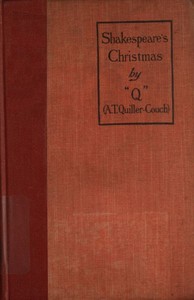
Shakespeare's Christmas, and other stories — Edition Insights
(0 User reviews)
1582
Project Gutenberg
2017
Not confirmed
Short stories, English; English fiction -- 20th century
Readers of public-domain and historical texts
Project Gutenberg digital edition
en
Edition facts
Words
73,441
Reading time
320 min
Text sections
8
Before opening Shakespeare's Christmas, and other stories — Edition Insights, the edition data offers a quick orientation: 73,441 words, 5 hr 20 min estimated reading time, and 8 detected text sections.
The text analysis averages about 17.5 words per sentence, while the detected sections provide another way to judge how the source is divided.
Project Gutenberg metadata also associates the work with “Short stories, English,” connecting these edition facts with the source record’s subject description.
Source:
Project Gutenberg record #54274
Seven stories by Arthur Quiller-Couch, ranging from a 1598 Shoreditch theatre on Christmas Eve to Cornish coastal mysteries. The collection showcases varied narrative voices, from theatrical banter to dialect-laden rural anecdotes, with shifts in pace between bustling scenes and slow-burning suspense.
Editorial Edition Score
4.7/5
★★★★★
★★★★★
Calculated from edition completeness, EPUB availability, text structure and catalogue metadata. Not a user rating.
How this score is calculated
- Description quality20 pts
- Title & short description10 pts
- Source metadata20 pts
- Text length15 pts
- Chapters / structure15 pts
- EPUB file integrity20 pts
Total of 100 points, scaled to a 2.5-5.0 range. Editions with an empty description or a missing EPUB file are not scored.
Edition quality
Read the Text
What was happening to Mistress Quickly and Doll Tearsheet? Poor souls, they were but children: they had meant no harm. For certain this plaguy fog was infecting the play; and yet, for all the fog, the play was a play no longer, but of a sudden had become savagely real. Why was this man turning on his puppets and rending them? The worst was, they bled--not sawdust, but real blood.
The apprentice cracked a nut and peeled it meditatively, with a glance along the bench. The countryman still fugled; the cutpurse cackled, with lips drawn back like a wolf's, showing his yellow teeth.
"Hist, thou silly knave!" said the apprentice. "Canst not see 'tis a tragedy?"
The rascal peered at him for a moment, burst out laughing, and nudged the countryman.
"Hi, master! Breeds your common at home any such goose as this, that cannot tell tickling from roasting?"
The apprentice cracked another nut. "Give it time," he answered. "I said a tragedy. Yours, if you will, my friend; _his_ too, may be"--with a long and curious stare at the countryman.
"_My tongue is weary: when my legs are too, I will bid you good-night: and so kneel down before you; but indeed to pray for the Queen._"
Play, epilogue, dance, all were over; the curtains drawn, the lanterns hidden behind them. The cutpurse had slipped away, and the countryman and apprentice found themselves side by side waiting while the gallery dissolved its crowd into the fog.
"A brisk fellow," remarked the one, nodding at the vacant seat as he stowed away his handkerchief. "But why should he guess me a rustic?"
"The fellow has no discernment," the apprentice answered dryly. "He even took the play for a merry one."
The countryman peered forward into the young-old face silhouetted against the glow which, cast upward and over the curtain-rod across the stage, but faintly reached the gallery.
"I love wit, Sir, wherever I meet it. For a pint of sack you shall prove me this play a sad one, and choose your tavern!"
"I thank you, but had liefer begin and discuss the epilogue: and the epilogue is 'Who's to pay?'"
"A gentleman of Warwickshire, Master What-d'ye-lack--will that content you? A gentleman of Warwickshire, with a coat-of-arms, or the College's promise--which, I take it, amounts to the same thing." The countryman puffed his cheeks.
"So-so?" The apprentice chuckled.
"_When we mean to build We first survey the plot, then search our pockets._
How goes it? Either so, or to that effect."
"The devil!" The countryman, who had been fumbling in his breek pockets, drew forth two hands blankly, spreading empty fingers.
"That was your neighbour, Sir: a brisk fellow, as you were clever enough to detect, albeit unserviceably late. I wish we had made acquaintance sooner: 'twould have given me liberty to warn you."
"It had been a Christian's merest duty."
"La, la, master! In London the sneaking of a purse is no such rarity that a poor 'prentice pays twopence to gape at it. I paid to see the play, Sir, and fought hard for my seat. Before my master gave over beating me, in fear of my inches and his wife (who has a liking for me), he taught me to husband my time. For your purse, the back of my head had eyes enough to tell me what befalls when a lean dog finds himself alongside a bone."
He seated himself on the bench, unstrapped a shoe, slipped two fingers beneath his stocking, and drew forth a silver piece. "If a gentleman of Warwickshire will be beholden to a poor apprentice of Cheapside?"
"Put it up, boy; put it up! I need not your money, good lad: but I like the spirit of that offer, and to meet it will enlarge my promise. A pint of sack, did I say? You shall sup with me to-night, and of the best, or I am a Dutchman. We will go see the town together, the roaring, gallant town. I will make you free of great company: you shall hear the talk of gods! Lord, how a man rusts in the country!--for, I will confess it to you, lad, the rogue hit the mark: the country is my home."
"I cannot think how he guessed it."
The collection opens with a scene set in a Shoreditch theatre on Christmas Eve, 1598, where the Lord Chamberlain's men perform a new comedy. The audience's enthusiastic response puzzles a cutpurse, who notes a red-faced countryman laughing so hard he rocks the bench. When the cutpurse warns him not to be mistaken for the author, the countryman replies with a cryptic joke: 'You shoot better than you know, my friend: the bolt grazes.' This exchange introduces a pattern of layered identities and playful misdirection that recurs across the seven stories.
Quiller-Couch shifts between brisk theatrical dialogue and more deliberate, atmospheric narration. In later tales, such as the one involving a parson returning to find whitewashed rocks and flags along the Cornish coast, the pace slows to accommodate puzzled exchanges and mounting unease. The contrast between the rapid-fire comedy of the opening and the measured, almost baffled tone of the coastal mystery demonstrates the author's range in voice and tempo.
Theatrical Banter and Narrative Speed
The first story, 'Shakespeare's Christmas,' relies on quick, overlapping dialogue to create a sense of crowded festivity. The cutpurse and the countryman trade remarks amid applause, and the countryman's aside—'The author? Ho-ho!'—is followed by a leap to his feet to lead another round of applause. This back-and-forth mimics the pace of a live performance, with interruptions and asides that keep the energy high. Quiller-Couch uses short lines and immediate reactions to compress time, making the reader feel the press of the audience.
In contrast, later stories adopt a more leisurely rhythm. The parson's return in the whitewash episode unfolds through careful description: the ferry-boat waiting, the constable's head-to-head conference, the slow walk up the foreshore. Dialogue becomes measured, with pauses and repetitions—'Aw, Parson dear,' says my grandfather, 'I'm glad you've come—yea, glad sure 'nuff.' The shift from rapid-fire to deliberate pacing mirrors the change from urban theatre to rural mystery, and Quiller-Couch adjusts his sentence length accordingly.
Dialect and the Texture of Voice
Quiller-Couch renders regional speech with precision, particularly in the Cornish-set tales. The grandfather's account includes phrases like 'We've a-been enjoying a terrible time!' and 'I only wish I could say yes or no: for 'twould be a relief even to know the worst.' These lines carry a distinct cadence, with dropped consonants and colloquial intensifiers that mark the speaker as local. The parson, by contrast, speaks in a more standard register, creating a linguistic divide that underscores his outsider perspective.
The author also uses dialect to control pace. When the grandfather hesitates to repeat the whitewasher's curse—'No, Sir, I can't; and as a minister of the Gospel, you'll never insist on it'—the broken sentence and trailing off slow the revelation, building suspense. Elsewhere, the cutpurse's 'furtive grin' and the countryman's 'mopping his brow' add physical texture to the voices. These vocal details are not mere decoration; they shape how quickly information is delivered and how the reader interprets character.
Shifts in Setting and Tonal Register
The settings move from a packed London theatre to the open coast of Cornwall, and the narrative voice adjusts accordingly. In the theatre, the prose is tight and immediate: 'Never had the Burbages played to such a house. It cheered every speech—good, bad, or indifferent.' The focus is on collective reaction and physical movement—leaping, mopping, grinning. Later, the coastal landscape is described in broader strokes: 'splashes of whitewash and little flags fluttering' stretching 'right away from Porthnavas down to the river's mouth.' The sentences lengthen, and the viewpoint becomes more observational.
This tonal shift also affects the pacing of revelation. In the theatre, the countryman's identity is hinted at through quick banter; in the Cornish story, the mystery unfolds through a series of puzzled questions and delayed answers. The parson 'stared from the rock to the stick and couldn't say,' and the grandfather's account is punctuated by dramatic pauses. Quiller-Couch uses the change in setting to modulate from high-spirited comedy to slow-burning curiosity, demonstrating his control over narrative tempo.
Readers attentive to voice will notice how Quiller-Couch varies his sentence rhythms to match the mood of each tale. The opening story's rapid exchanges give way to the deliberate, almost baffled tone of the later mysteries. Pay particular attention to the way dialect slows or accelerates the delivery of key information, and to how the author uses physical details—a mopped brow, a whitewashed rock—to anchor shifts in pace. These stories reward a careful ear for the texture of spoken language.
Years among the shelves taught me that Quiller-Couch’s Christmas players, nervous before a Shoreditch crowd, share a quiet kinship with the steadfast souls guarding Captain Hayward. Both books whisper of duty worn lightly, of courage under strange skies. I often find them sitting together now, The Prisoner of the Mill; or, Captain Hayward's "Body Guard" — Themes and Context beside that old Cornish collection, two old friends nodding across the dust.
There are no reviews for this eBook.
There are no comments for this eBook.
Reader reflection
Before you leave, reflect on the book
Use these questions to collect your thoughts before moving on.
Your progress
0
/
10
2
What was your overall reaction to the book?
3
Would you pass this book on to a friend?
4
How demanding did the text feel?
5
What did you think about the pace?
6
How understandable was the text?
7
Did the book give you something worth debating?
8
Did the book deliver what you hoped for?
9
What is the main idea you are taking away?
10