1

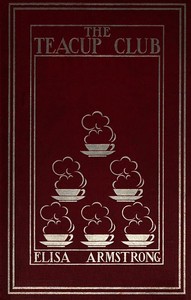
The Teacup Club — Reading Notes
(0 User reviews)
719
Project Gutenberg
2015
Not confirmed
Women -- Fiction; Man-woman relationships -- Fiction
Readers of public-domain and historical texts
Project Gutenberg digital edition
en
Edition facts
Words
56,333
Reading time
245 min
Text sections
15
The source record for The Teacup Club — Reading Notes measures this digital text at 56,333 words, 4 hr 5 min estimated reading time, and 15 detected text sections.
The text analysis averages about 17.9 words per sentence, while the detected sections provide another way to judge how the source is divided.
Project Gutenberg metadata also associates the work with “Women -- Fiction,” connecting these edition facts with the source record’s subject description.
Source:
Project Gutenberg record #50751
A serialized novel from 1899 following a club of young women who debate marriage, politics, bicycling, and the 'New Woman' through witty dialogue. The excerpts reveal a pattern of ironic contrasts between stated ideals and practical compromises, with recurring motifs of broken engagements, domestic negotiations, and the tension between independence and social expectation.
Editorial Edition Score
4.7/5
★★★★★
★★★★★
Calculated from edition completeness, EPUB availability, text structure and catalogue metadata. Not a user rating.
How this score is calculated
- Description quality20 pts
- Title & short description10 pts
- Source metadata20 pts
- Text length15 pts
- Chapters / structure15 pts
- EPUB file integrity20 pts
Total of 100 points, scaled to a 2.5-5.0 range. Editions with an empty description or a missing EPUB file are not scored.
Edition quality
Read the Text
ce, too, and gotten nothing out of it!”
“Perhaps he—he did it hoping to please you, dear.”
“His actions are perfectly indifferent to me, I assure you. Besides, if I made up with him to-morrow, Frances would always think I was jealous. I jealous of her—the idea! And, oh, Emily, the way he—he flirts with that girl is enough to b—break my heart!”
“If you two girls have anything interesting to say, I wish you would say it aloud,” broke in the president. “Of course I am not curious, but some of the others may—”
“Nothing at all interesting,” said the blue-eyed girl, promptly; “I—I was just telling Emily that this club seems the one thing needed to fill my cup of happiness to overflowing!”
“And mine!” said the girl with the Roman nose. “By the way, isn’t it too provoking that curls are coming in again, just as veils are going out!”
“And just at the windiest season of the year, too,” wailed the brown-eyed blonde. “Really, I often think that the fashions are invented by men—they are so contrary!”
“Pardon me,” said the president, “I did not quite catch what you were saying, because Emily and Marion were both talking at the same time. It seems to me that since I have been married, I can’t follow even two conversations simultaneously, as I used.”
“Speaking of that,” said the girl with the eyeglasses, “who do you tell your secrets to now that you are married?”
“Why, I’ve hit on a splendid plan,” cried the president, “when I feel that I must just tell a secret or die—and I often feel that way—I wait until Tom is asleep and repeat the whole story in his ear. It relieves my mind and does no harm.”
“Don’t be too sure of that,” said the girl with the dimple in her chin. “My sister Helen doesn’t agree with you at all. You mentioned it to her the other day and she thought it clever, and resolved to emulate your wisdom, so she tried it on her husband, and he wasn’t asleep, only pretending.”
“But I always test my husband with a question or two, first,” said the president.
“So did Helen. She asked him if he could fail to see how much she needed a new bonnet and wanted to know how much his share of the alumni banquet amounted to. He only snored in reply, and of course she thought she was safe and repeated the secret.”
“With the result?” queried the blue-eyed girl, who was listening, breathless.
“That it was all over his club the next day,” said the girl with the dimple in her chin. “It would not have made any difference,” she added, soberly, “only the secret was a rather clever trick I had played on Dick a few days before—and he belongs to the same club!”
“And yet they say a man can keep a secret!” said the girl with the Roman nose.
“Who says so?” queried the girl with the eyeglasses. “Other men? Oh! I didn’t know but that you had heard some woman say so.”
“Not unless a man was listening, dear, and that man a person whom—”
“She wished to flatter immensely!”
“Yes. Or who happened to know some of her own secrets! Girls, I’ve been wondering what on earth Annie sees in that horrid Fred Van Stupid? Now, I can understand the interest a girl takes in a brainless man who has a great deal of money, because then—”
“He is exposed to so many temptations and her influence is sure to do him good,” finished the girl with the dimple in her chin, “for my part, I always let Ned Goldie come to see me oftener than usual during Lent. I feel that I am really doing some good and—”
“Violets are an absolute necessity then and they are so dear that very few men can afford to present them in quantities.”
“Oh, of course I let him bring me flowers if he wants to—it is so much better for him to spend his money in that way than to lose it at poker, that I feel quite a missionary.”
“H’m; I don’t know about that, dear, though it’s very lovely of you to feel so,” sighed the president, “the fact is, that you are actually encroaching on what is really my violet money. Ned will play poker with my husband at the club at other seasons of the year, when he is not allowed to see much of you. He always loses and I make Tom divide his winnings with me, so—”
The Teacup Club opens not with a constitution but with a broken engagement. Dorothy, the blue-eyed girl, announces she has sent back Jack's ring—for the third or fourth time, her friend Emily notes. The ring's messenger fees have already exceeded its value, a small detail that signals the book's method: serious subjects approached through comic, material particulars. The club itself forms around tea-pouring and conversation, yet its members immediately tackle woman's place in politics, the heroines of the day, and currency problems. The dialogue moves in quick, ironic exchanges where a character's assertion is undercut by her own actions or by a friend's pointed memory. This is a world where ideals are stated and immediately qualified, where the desire for progress coexists with the need to manage fathers, cooks, and fiancés.
The Art of Strategic Compliance
The excerpts show a recurring pattern: the women negotiate for autonomy by appearing to conform. When Dorothy wants a bicycle, her father demands she first bake a good pie. She agrees, then delegates the baking to the cook in exchange for trimming a hat—"It was really quite the same you know." The cook produces an inedible pie, so Dorothy buys one from the Woman's Exchange and declares she "quite deserved the bicycle after all I had been through to earn it." The humor lies in the gap between the stated bargain (domestic skill for freedom) and the actual transaction (social manipulation for a purchased pie). Similarly, Emily's bicycle story involves Dick failing to help her after a fall, but his later explanation—that he couldn't stop—is accepted without irony. The club members treat such compromises as practical wisdom, not hypocrisy.
Bicycles as Social Currency
Bicycles appear repeatedly as objects that enable both freedom and comedy. The women discuss learning to ride in terms of physical injury and social embarrassment: one fell on her face so often she became "unrecognizable" and could fall up and down her own street; another learned in a lovely suit that was nearly destroyed. The bicycle becomes a pretext for negotiating with fathers, a topic of conversation with strange men, and a source of marital farce—as in the story of the scorcher who runs into his own wife and tries to flee. The club president's anecdote about a man who hits a woman and discovers it's his wife is told with relish, and Dorothy responds "Good!" The bicycle, like the club itself, is a space where gender roles are tested but not overturned, where independence is pursued through indirection.
The Club as a Forum for Contradiction
The Teacup Club is formed to discuss serious topics—politics, legislation, theosophy—but the excerpts show the conversation constantly veering into personal anecdote and social maneuvering. The chapter titles promise systematic debate, but the dialogue is associative, ironic, and self-interrupting. When Dorothy declares men are "never really practical," Emily immediately praises her cleverness and suggests she study law instead of marrying Jack—then undercuts the compliment by mentioning Jack again. The club's discussions are less about reaching conclusions than about displaying wit and managing relationships. The structure of the book, with its twelve chapters on distinct topics, may be a frame for a series of conversational set-pieces rather than a sustained argument. Readers should expect the pleasures of repartee and character revelation rather than doctrinal consistency.
The Teacup Club rewards attention to its small details: the ring sent back multiple times, the pie bought from the Woman's Exchange, the bicycle story that ends with a wife. These are not decorations but the book's primary method—using concrete, comic situations to explore the gap between what the New Woman says and what she does. The club members are neither rebels nor conformists; they are negotiators, and their negotiations are the real subject. Read for the texture of the talk, the rhythm of interruption and retort, and the way serious proposals dissolve into laughter or practical arrangement.
It’s funny how a century-old conversation can still feel so familiar. Reading that tea club’s banter about marriage and bicycles reminded me of the quiet ache in The Mentor: American Pioneer Prose Writers, Vol. 4, Num. 6, Serial No. 106, May 1, 1916 — Context and Discussion, where those same compromises whisper between the lines. It lingered, like a half-remembered afternoon.
There are no reviews for this eBook.
There are no comments for this eBook.
Reader reflection
How did this book work for you?
Your answers remain private and are stored only in this browser.
Your progress
0
/
10
2
How much did you enjoy the reading experience?
3
Would you recommend this book to another reader?
4
How easy was the book to follow?
5
Did it raise ideas you would like to talk about?
6
How did the reading compare with what you expected?
7
Did anything about the book feel genuinely new?
8
What was the strongest part of the book?
9
What changed or sharpened your thinking?
10