1

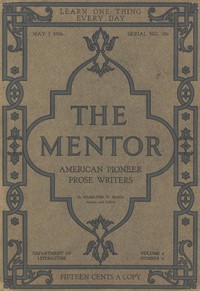
The Mentor: American Pioneer Prose Writers, Vol. 4, Num. 6, Serial No. 106, May 1, 1916 — Context and Discussion
(0 User reviews)
621
Project Gutenberg
2016
1916
Authors, American; American prose literature
Readers of public-domain and historical texts
Project Gutenberg digital edition
en
Edition facts
Words
12,274
Reading time
54 min
Text sections
7
This digital edition of The Mentor: American Pioneer Prose Writers, Vol. 4, Num. 6, Serial No. 106, May 1, 1916 — Context and Discussion is described by source-level measurements including 12,274 words, 54 min estimated reading time, and 7 detected text sections.
The text analysis averages about 17.4 words per sentence, while the detected sections provide another way to judge how the source is divided.
Project Gutenberg metadata also associates the work with “Authors, American,” connecting these edition facts with the source record’s subject description.
Source:
Project Gutenberg record #51731
This editorial note examines the structure and recurring imagery in Hamilton Wright Mabie's 1916 survey of early American prose writers, focusing on how the text moves between biographical sketches and literary analysis, and how images of youth, observation, and cosmopolitanism recur across the profiles of Edwards, Brown, Irving, and others.
Editorial Edition Score
4.6/5
★★★★★
★★★★★
Calculated from edition completeness, EPUB availability, text structure and catalogue metadata. Not a user rating.
How this score is calculated
- Description quality20 pts
- Title & short description10 pts
- Source metadata20 pts
- Text length15 pts
- Chapters / structure15 pts
- EPUB file integrity20 pts
Total of 100 points, scaled to a 2.5-5.0 range. Editions with an empty description or a missing EPUB file are not scored.
Edition quality
Read the Text
Although Brown’s books make heavy reading, yet his companionships were of the liveliest. It was said that no man ever had truer friends or loved these friends better. One of his closest friends was Dr. Eli Smith, a literary man. It was through him that Brown was introduced into the Friendly Club of New York City, where he met many other workers in the literary field. And it was under their influence that he produced his first, important work.
This was a novel published in 1798, called “Wieland, or the Transformation.” A mystery, seemingly inexplicable, is solved as a case of ventriloquism, which at that time was just beginning to be understood thoroughly. His next book was “Arthur Mervyn,” remarkable for its description of the epidemic of yellow fever in Philadelphia. “Edgar Huntley,” a romance rich in local color, followed this. An effective use is made of somnambulism, and in it Brown anticipates James Fenimore Cooper’s introduction of the American Indian into fiction.
The novelist then wrote two novels dealing with ordinary life; but they proved to be failures. Then he began to compile a general system of geography, to edit a periodical, and to write political pamphlets; but all the time his health was failing. On February 22, 1810, he died of tuberculosis.
His biographer, William Dunlap, who was the novelist’s friend, says that Brown was the purest and most amiable of men, due perhaps to his Quaker education. His manner was at times a little stiff and formal; but in spite of this he was deeply loved by his friends.
PREPARED BY THE EDITORIAL STAFF OF THE MENTOR ASSOCIATION ILLUSTRATION FOR THE MENTOR, VOL. 4, No. 6, SERIAL No. 106 COPYRIGHT, 1916, BY THE MENTOR ASSOCIATION, INC.
American Pioneer Prose Writers
Monograph Number Four in The Mentor Reading Course
A bankruptcy produced one of the greatest American writers. If the business house with which Washington Irving was associated had not failed, he might never have seriously attempted to take up literature.
Washington Irving was born in New York City on April 3, 1783. He was named after George Washington, who at that time was the idol of the American people. Both his parents were immigrants from Great Britain. His father was a prosperous merchant at the time of Irving’s birth.
Irving was a mischievous boy. Perhaps this was due to the fact that Deacon Irving was a severe father. He detested the theater, and permitted no reading on Sunday except the Bible and the Catechism. Washington was permitted on weekdays to read only Gulliver’s Travels and Robinson Crusoe. Nevertheless, in spite of his father’s strictness, the boy managed to steal away from home to attend the theater.
Irving intended to be a lawyer; but his health gave way, and he had to take a voyage to Europe. In this journey he went as far as Rome, and in England made the acquaintance of Washington Allston, the famous American painter, who was then living there. On his return he was admitted to the bar; but he made little effort at practising.
In the meanwhile, however, he, his brother William, and J. K. Paulding wrote some humorous sketches called “Salmagundi Papers,” which were quite successful.
About this time came the single romance of Irving’s life. Judge Hoffman, in whose law office he was, had a daughter named Matilda. The young lawyer fell in love with her; but this romance was brought to a tragic end by her death. Irving never married, remaining true throughout life to the memory of this early attachment.
Irving’s first important piece of writing was the Knickerbocker History of New York. It was a clever parody of a history of the city published by Dr. Samuel Mitchell. The book was received with enthusiasm by the public, and Irving’s reputation was made.
His health, never of the best, again gave way. In 1815 he revisited Europe, and made the acquaintance of many important people there, including Disraeli, Campbell, and Scott. The business in which he was a silent partner fell into bad conditions and ended with a bankruptcy which left Irving virtually without resources. His brother, who was an influential member of Congress, secured for him a secretaryship in the United States Navy Department with a salary of $2,500 a year; but Irving declined this, with the intention of writing for a living.
The Mentor: American Pioneer Prose Writers opens with a striking rhetorical move: a prefatory essay titled "Fame In Name Only" that chides readers for owning books they never open. This framing device sets the tone for the entire volume, positioning the biographical sketches that follow not as dry reference entries but as invitations to renewed engagement. Hamilton Wright Mabie structures each profile as a compact narrative, moving from birth and education through key works and critical reception, yet he repeatedly interrupts this chronological flow with evaluative judgments—declaring Jonathan Edwards "one of the most impressive figures of his time" while later dismissing Charles Brockden Brown's work as "sentimental and unreal." The result is a text that oscillates between factual report and personal assessment, creating a distinctive rhythm of assertion and qualification.
Youth as a Recurring Motif
Across the profiles, Mabie consistently foregrounds the early years of his subjects, often with a detail that seems chosen to foreshadow later achievement. Jonathan Edwards is described as a boy who "never played the games, or got mixed up in the mischief that the usual boy indulges in," and who wrote a tract on the soul at age ten and an essay on the "Flying Spider" at twelve. Washington Irving, by contrast, "declined to go to college, as his brothers had gone, but read law and, probably with greater avidity, books of general literature." The contrast is instructive: Edwards's disciplined precocity and Irving's gentlemanly loitering are both presented as early signs of their respective literary temperaments. This pattern of highlighting youthful behavior as a key to adult character recurs throughout the volume, giving the biographical sketches a consistent psychological framework.
The Observer and the Loiterer
Mabie's language for describing his subjects' habits of attention reveals a persistent interest in the act of observation itself. Irving is called "a born observer and loiterer, a man who saw and felt and meditated." The Quaker writer John Woolman is praised for his "unaffected and intimate record of his thoughts, feelings, and experiences" in his Journal, which Mabie calls "real literature" precisely because of its purity of style and beauty of feeling. Even the negative assessment of Brown's work—"sentimental and unreal, and lacked art"—implies a standard of truthful observation that the author values. The volume thus builds a quiet argument about what makes prose endure: not plot or philosophy alone, but a quality of attention that the writer brings to experience.
Movement Between City and Country
The geographical settings in these profiles are not mere background; they function as active elements in the literary development Mabie traces. New York City appears as "the most cosmopolitan of all cities of the New World," a place where "eighteen languages were already spoken" by the time of the Revolution, and where Irving's Knickerbocker History could burlesque the ancestors of prominent families. The Hudson River valley, settled by the Dutch, provides picturesque traditions. In contrast, Edwards's Northampton, Massachusetts, is the site of a "great revival in religion" that shapes his theological writing. This movement between urban sophistication and rural revivalism gives the volume a spatial dimension, suggesting that American prose emerged from the tension between these two poles.
The Structure of Literary Judgment
Mabie's critical assessments are woven into the biographical narrative in a way that rewards close attention to his phrasing. He declares Edwards "a deep thinker, a strong writer, a powerful theologian, and a constructive philosopher"—four adjectives that escalate from intellectual to institutional. Of Irving's Knickerbocker History, he writes that it was "the first book of quality and feeling written by an American," a claim that implicitly ranks earlier colonial writing as lesser. Brown's work, by contrast, is said to have "little permanent value" despite its "morbid psychology and a certain kind of intensity." These judgments are not argued at length but stated as facts, giving the volume an authoritative tone that modern readers may find both useful and provocative. The criteria—quality, feeling, purity, reality—are never explicitly defined, but they form a consistent evaluative framework.
Readers approaching this volume should attend to the way Mabie uses brief anecdotes and evaluative asides to shape his portraits. The text rewards those who notice how a single phrase—"a born observer and loiterer"—can encapsulate an entire literary philosophy. Because the excerpts are incomplete, the full arc of Mabie's argument about the development of American prose remains partially obscured, but the patterns visible here offer a rich starting point for considering how early twentieth-century critics constructed a national literary tradition.
Reading Mabie’s sketches of those early American pens, I kept thinking of the quiet parlors in Blue-Stocking Hall, (Vol. 2 of 3) — Edition Insights—not the arguments, but the long pauses between them. There, too, one feels the weight of observation over action, the same gentle patience with character that Mabie affords his pioneers. It lingered with me afterwards.
There are no reviews for this eBook.
There are no comments for this eBook.
Reader reflection
What did you think of this book?
Answer a few questions and save a private reflection on this device.
Your progress
0
/
10
2
Did this book hold your interest?
3
Is this a title you would suggest to others?
4
How demanding did the text feel?
5
Did any part of the book stay with you emotionally?
6
Did the book give you something worth debating?
7
Was the book easy to understand?
8
Did you relate to its people, ideas, or situations?
9
What did this book teach you most?
10