1

A Dog Day; or, The Angel in the House — Edition Insights
(0 User reviews)
56
Project Gutenberg
2016
Not confirmed
Dogs -- Fiction; Dogs -- Humor
Readers of public-domain and historical texts
Project Gutenberg digital edition
en
Edition facts
Words
4,877
Reading time
22 min
Text sections
2
A Dog Day; or, The Angel in the House — Edition Insights can be approached with a clearer sense of reading commitment from its source measurements: 4,877 words, 22 min estimated reading time, and 2 detected text sections.
The text analysis averages about 16.8 words per sentence, while the detected sections provide another way to judge how the source is divided.
Project Gutenberg metadata also associates the work with “Dogs -- Fiction,” connecting these edition facts with the source record’s subject description.
Source:
Project Gutenberg record #51306
Walter Emanuel's 1902 comic novella presents a dog's diary entries chronicling a single day, from thwarting a burglar to enduring a bath, with sharp canine observations on human behavior.
Editorial Edition Score
4.5/5
★★★★★
★★★★★
Calculated from edition completeness, EPUB availability, text structure and catalogue metadata. Not a user rating.
How this score is calculated
- Description quality20 pts
- Title & short description10 pts
- Source metadata20 pts
- Text length15 pts
- Chapters / structure15 pts
- EPUB file integrity20 pts
Total of 100 points, scaled to a 2.5-5.0 range. Editions with an empty description or a missing EPUB file are not scored.
Edition quality
Read the Text
Note: Project Gutenberg also has an HTML version of this file which includes the original illustrations. See 51306-h.htm or 51306-h.zip: (http://www.gutenberg.org/files/51306/51306-h/51306-h.htm) or (http://www.gutenberg.org/files/51306/51306-h.zip)
Images of the original pages are available through Internet Archive. See https://archive.org/details/dogdayorangelinheman
Text enclosed by underscores is in italics (_italics_).
The Angel in the House
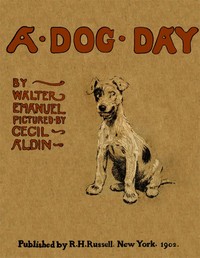
Pictured by Cecil Aldin
Published by R.H.Russell. New York. 1902.
------------------------------------------------------------------------
Copyright, 1902, by William Heinemann. All rights reserved. Entered at Stationers Hall, London, England. Entered at the Library of Congress, Washington, U.S.A.
------------------------------------------------------------------------
------------------------------------------------------------------------
THE ANGEL IN THE HOUSE
Woke up feeling rather below par, owing to disturbed rest. Hardly enough energy to stretch myself. In the middle of the night a strange man came in by the kitchen window, very quietly, with a bag. I chummed up to him at once. He was nice to me, and I was nice to him. He got me down a piece of meat that I could not reach myself. While I was engaged on this, he took a whole lot of silver things and put them into the bag. Then, as he was leaving, the brute—I believe, now, it was an accident—trod on my toe, making me yelp with pain. I bit him heartily, and he dropped his bag, and scurried off through the window again. My yelping soon woke up the whole house, and, in a very short time, old Mr. Brown and young Mr. Brown appear. They at once spot the bag of silver. They then declare I have saved the house, and make no end of fuss with me. I am a hero. Later on Miss Brown came down and fondled me lots, and kissed me, and tied a piece of pink ribbon round my neck, and made me look a fool. What’s the good of ribbon, I should like to know? It’s the most beastly tasting stuff there ever was.
Ate breakfast with difficulty. Have no appetite.
Ate kittens’ breakfast.
An affair with the cat (the kittens’ mother). But I soon leave her, as the coward does not fight fair, using claws.
Washed by Mary. A hateful business. Put into a tub, and rubbed all over—mouth, tail, and everywhere—with filthy soapy water, that loathsome cat looking on all the while, and sneering in her dashed superior way. I don’t know, I am sure, why the hussy should be so conceited. She has to clean herself. I keep a servant to clean me. At the same time I often wish I was a black dog. They keep clean so much longer. Every finger-mark shows up so frightfully on the white part of me. I am a sight after Cook has been stroking me.
Showed myself in my washed state to the family. All very nice to me. Quite a triumphal entry, in fact. It is simply wonderful the amount of kudos I’ve got from that incident with the man. Miss Brown (whom I rather like) particularly enthusiastic. Kissed me again and again, and called me “a dear, clean, brave, sweet-smelling little doggie.”
While a visitor was being let in at the front-door I rushed out, and had the most glorious roll in the mud. Felt more like my old self then.
Visited the family again. Shrieks of horror on seeing me caked in mud. But all agreed that I was not to be scolded to-day as I was a hero (over the man!). All, that is, except Aunt Brown, whose hand, for some reason or other, is always against me—though nothing is too good for the cat. She stigmatised me, quite gratuitously, as “a horrid fellow.”
Glorious thought! Rushed upstairs and rolled over and over on the old maid’s bed. Thank Heaven, the mud was still wet!
Down into kitchen. While Cook is watching regiment pass, I play with chops, and bite big bits out of them. Cook, who is quite upset for the day by seeing so many soldiers, continues to cook the chops without noticing.
Attacked by beast of cat again. She scratched my hind-leg, and at that I refused to go on. Mem.: to take it out of her kittens later.
Upstairs into dining-room. Family not finished lunch yet. Young Mr. Brown throws a bread pellet at me, hitting me on the nozzle. An insult. I swallow the insult. Then I go up to Miss Brown and look at her with my great pleading eyes. I guessed it: they are irresistible. She gives me a piece of pudding. Aunt Brown tells her she shouldn’t. At which, with great pluck, Miss Brown tells her to mind her own business. I admire that girl more and more.
Walter Emanuel's A Dog Day; or, The Angel in the House (1902) adopts the conceit of a diary kept by a dog, recording events from 7 AM onward with a voice that is both naive and shrewd. The opening entry immediately establishes a distinctive canine perspective: the dog wakes feeling 'below par' after a disturbed night, then recounts an encounter with a burglar whom he initially befriends because the man offers meat. This moment encapsulates the book's central technique—filtering human drama through a creature who values food and comfort over property, yet whose actions inadvertently make him a hero.
A Canine Voice with Human Ironies
The dog's narration is marked by a consistent, colloquial tone that blends animal instincts with a surprisingly human-like sense of grievance and pride. He describes being washed as 'a hateful business' and resents the cat's 'dashed superior way' while simultaneously noting that he 'keeps a servant' to clean him—a wry inversion of domestic hierarchy. The diary format allows Emanuel to juxtapose the dog's mundane concerns (appetite, comfort, social slights) with the family's perception of him as a 'dear, clean, brave, sweet-smelling little doggie.' This gap between the dog's self-image and the humans' sentimental view generates much of the humor. The dog's voice is consistent: he uses short, declarative sentences, often beginning with time stamps, and his priorities—food, sleep, avoiding the cat—remain stable throughout the excerpts.
Structure and the Illusion of Real Time
The narrative is organized by precise time stamps ('A.M. 7,' '8:30,' '8:35,' '8:36'), creating the impression of a real-time chronicle. This structure mimics a human diary but is filled with dog-appropriate content: eating, sleeping, being washed, and interacting with other animals. The rapid succession of entries—sometimes minutes apart—emphasizes the dog's short attention span and the episodic nature of his day. The burglar incident, which might be the climax of a human story, is presented matter-of-factly, with the dog more upset about having his toe trodden on than about the theft. The time stamps also allow Emanuel to compress a full day into a short text, giving the reader a sense of the dog's routine while highlighting the absurdity of applying human diary conventions to a non-human subject.
Diction and the Dog's Worldview
Emanuel carefully selects vocabulary that reflects the dog's limited but expressive worldview. The dog uses words like 'chummed up,' 'beastly,' 'hussy,' and 'coward' to describe other animals and humans, anthropomorphizing himself while remaining recognizably canine. He refers to the cat as 'the kittens’ mother' and notes that she 'does not fight fair, using claws'—a detail that shows his understanding of species-specific combat rules. The dog's irritation at being made to 'look a fool' with a pink ribbon reveals a vanity that is both dog-like (disliking the taste of ribbon) and human-like (concerned with appearance). These linguistic choices create a consistent character who is neither fully animal nor fully human, but a comic hybrid whose observations expose the absurdities of Edwardian domestic life.
Setting and Social Hierarchy Through Canine Eyes
The domestic setting is evoked through the dog's interactions with various household members: 'old Mr. Brown and young Mr. Brown,' 'Miss Brown,' 'Cook,' and 'Mary' the maid. The dog distinguishes between them based on how they treat him—Miss Brown kisses him and ties on ribbons, while Mary subjects him to baths. This hierarchy mirrors the human social order but is filtered through the dog's own values: he values those who feed him and dislikes those who wash him. The burglar is initially judged positively because he provides meat, and only later condemned for stepping on the dog's toe. The setting—a middle-class home with silverware, a kitchen window, and a cat—is rendered entirely through the dog's sensory experiences: smells, tastes, and physical sensations. This limited perspective forces the reader to infer the human drama from canine reactions, creating a comedy of misalignment.
Readers should approach A Dog Day as a sustained exercise in point of view, where the humor depends on the gap between the dog's priorities and the humans' interpretations. The diary form rewards attention to small details—the dog's changing appetite, his grudges, his moments of pride—that collectively build a character who is both comic and oddly sympathetic. The brevity of the text (under 5,000 words) makes it a quick read, but the precision of Emanuel's canine voice invites rereading to appreciate how consistently he maintains the conceit.
That rainy afternoon, the dog’s diary made me laugh at how seriously we take our little routines—baths, burglars, breakfast. His bemused patience felt familiar. Later, idly tracing that thread of quiet endurance through history, I stumbled upon Redcoat Captain: A Story of That Country — A Closer Reading, which carries a similar, unspoken weariness in a different uniform. Strange how a wet dog led me there.
There are no reviews for this eBook.
There are no comments for this eBook.
Reader reflection
Your personal reading reflection
Build a private reading journal entry for this title.
Your progress
0
/
10
2
What was your overall reaction to the book?
3
Would you pass this book on to a friend?
4
What was the reading difficulty like?
5
Was the book what you thought it would be?
6
Which aspect of the book did you value most?
7
Did it raise ideas you would like to talk about?
8
Was the book easy to understand?
9
What did this book teach you most?
10