1

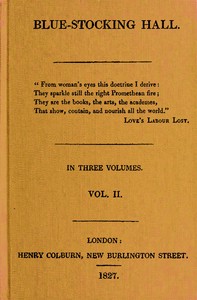
Blue-Stocking Hall, (Vol. 2 of 3) — Edition Insights
(0 User reviews)
703
Project Gutenberg
2016
Not confirmed
Epistolary fiction; Women -- Conduct of life -- Fiction; Women -- Education -- Fiction
Readers of public-domain and historical texts
Project Gutenberg digital edition
en
Edition facts
Words
64,236
Reading time
280 min
Text sections
20
The catalog record for Blue-Stocking Hall, (Vol. 2 of 3) — Edition Insights provides practical reading context through 64,236 words, 4 hr 40 min estimated reading time, and 20 detected text sections.
The text analysis averages about 31.6 words per sentence, while the detected sections provide another way to judge how the source is divided.
Project Gutenberg metadata also associates the work with “Epistolary fiction,” connecting these edition facts with the source record’s subject description.
Source:
Project Gutenberg record #52375
In this epistolary novel, letters reveal debates on women's education and conduct, with a notable editorial note about chronological placement. The second volume shifts from domestic settings to a lake district journey, where a boatmen's silent tribute to a drowned man and a spontaneous subscription for his widow showcase Scargill's interest in moral sentiment and social class.
Editorial Edition Score
4.8/5
★★★★★
★★★★★
Calculated from edition completeness, EPUB availability, text structure and catalogue metadata. Not a user rating.
How this score is calculated
- Description quality20 pts
- Title & short description10 pts
- Source metadata20 pts
- Text length15 pts
- Chapters / structure15 pts
- EPUB file integrity20 pts
Total of 100 points, scaled to a 2.5-5.0 range. Editions with an empty description or a missing EPUB file are not scored.
Edition quality
Read the Text
ery thought expressed by either, meets from the other a response of delighted affection, whilst a joyous band of happy youth disport around them, whose only rivalry consists in trying who shall contribute most to the general stock of happiness, and pay most attention to the cherished authors of their being.
I fancy that I hear you exclaim, "How can Elizabeth hesitate? Why not cultivate the Stanleys, and forget that there is a vulgar world to be passed by?" I will tell you why Elizabeth doubts what path to choose. These inestimable persons are stigmatized by the paltry and mindless animals who environ them, and the Miss Stanleys are yclept blues, while all the rest are called philosophers.
For _myself_ you know, that I have no possible feeling upon such a subject. Were I called _Blue_, because I was seen with the Stanleys, or reading any thing but a novel, it would not signify. _My_ walk in life has long been determined, and I have outlived (if indeed I ever felt like the Mimosa upon such occasions) all sensibility to those nick-names, which are so generously bestowed upon single women. I am a _veteran_, and can stand fire. I can endure to be called by any appellation, the _true_ meaning of which, is that I have preferred remaining unmarried to being encumbered by the cares of wedded life; and if heaven have granted any measure of understanding, have chosen to employ, rather than let it lie fallow. But this is my individual view of the matter. Have I a right to place my _nieces_ in society which they would certainly love and imitate? am I to incur for them the obloquy that waits on superior knowledge and acquirements in their sex? impeding perhaps, also, the chances of that settlement in future life which, though I have never desired for myself, and am in reality very indifferent about for them, I am still bound to consider as the ordinance of nature, besides being the point to which the artificial laws of the world are universally directed. Many cares will necessarily spring up in my way as I proceed, but at present, how to steer a middle course between Scylla and Charybdis is my chief difficulty. With the inanity of fashion, and its opposite vulgarity on the one hand; a religion which deals too much in external observances, and the reproach of female _learning_ on the other, is there any _honest_ method by which, without sacrificing integrity of principle, I may _skim the cream_ of _each_ class, and save my children from the evils attendant upon _all_ the classes that I have described? Be my Cumean Sybil; look into the page of destiny for me; say what is before me, and how I shall act.
The priest in the proverb, "christens his own child first;" you see that I have adopted the same prudent maxim, and given you nothing as yet, but my own story; but for this you need no apology my dearest Caroline. Innumerable interruptions break my purposes, and deprive me of any command over my time just now. By and by I shall be able to write less selfishly I trust, and repay your kindness by more agreeable matter than you will find in a _dish_ of egotism which I have served up for your this day's fare. Before I release you, however, I must tell you that I was not a little surprised yesterday, by the appearance of an Irish acquaintance, Mr. Bentley, whom I have seen frequently at Lisfarne, and uncle to George, who is, I believe, an intimate still at your house, and Mr. Otway's. When I was at Glenalta, the young man was, I suppose, at the University, for I did not see him, but I heard the girls and Frederick name him familiarly.
In the midst of giving directions to my work-men, a travelling carriage drove up to the hall-door, and I was really delighted to see Mr. Bentley, who is a highly respectable man, but who appeared in a new light of interest to my eyes, from all the associations which his presence awakened. I endeavoured to shew how glad I felt to see him; and though I could not prevail with him to make a longer stay, he indulged me by remaining, to pass a few hours, and walk round our pretty grounds. In the course of conversation, I asked for his nephew, and was answered, that he was at Lisfarne, where he would remain till Mr. Bentley, senior, returns to the county of Kerry. I spoke of the advantage which any young person must derive from such society as that of Mr. Otway, upon whose character I expatiated with my usual warmth.
Volume 2 of Blue-Stocking Hall opens with an editorial intrusion unusual in epistolary fiction: a note explaining that Mr. Otway's letter to General Douglas is inserted out of chronological order for narrative coherence. This small editorial gesture signals that the novel's sequence of letters is not merely a transparent record but a constructed arrangement, inviting readers to attend to the shaping hand behind the correspondence. The letter itself, discussing the purchase of an estate in Hampshire and the moral obligations of returning absentee landlords, establishes the volume's preoccupation with property, duty, and the proper use of wealth.
The Editor's Interruption and Epistolary Structure
The editorial note preceding Letter XII is a rare moment in which the novel acknowledges its own artifice. By stating that the letter 'should not appear till later in the series' but is inserted here for expediency, the editor—whether Scargill or a fictional persona—draws attention to the temporal manipulation inherent in the epistolary form. This is not a simple collection of letters but a curated sequence, where the order of reading may differ from the order of writing. Readers of volume 2 should watch for other such editorial interventions, which may hint at gaps or rearrangements in the correspondence. The note also raises questions about the reliability of the narrative timeline: events described in one letter may presuppose knowledge from a later one, creating a layered reading experience that rewards attention to dates and cross-references.
The Lake District Journey and Moral Sentiment
The second excerpt shifts from the drawing-room debates of the first volume to a vividly described journey through the Lake District. The narrative voice becomes more descriptive and leisurely, dwelling on the 'narrow strait of exquisite beauty' and the boatmen's 'joyous cry' as they haul boats upstream. This scenic interlude is abruptly shadowed by the discovery of a drowned man, Florence O'Neil, whose body is found 'extricated from a bed of arbutus.' The boatmen's response—drawing the boat in 'profoundest stillness' as a tribute—is presented as a mark of 'delicate feeling' that 'would have adorned a far higher class in life.' Scargill uses this incident to dramatize the moral sensibility of working-class characters, contrasting their spontaneous compassion with the more calculated benevolence of the gentry. The episode culminates in Mrs. Douglas's proposal to collect a subscription for the widow, transforming sentiment into practical charity.
Voice and Class in the Boatmen's Dialogue
The boatmen's speech is rendered with a distinct regional and class inflection, most notably in M'Carty More's address to the passengers: 'I hope that your honours will not take it amiss if we draw up the boat silent and quiet, like the poor fellow himself that lay here this morning.' The phrasing is formal yet colloquial, and the deference to 'your honours' is undercut by the quiet dignity of the request. Later, when Russell teases M'Carty about being flattered to deliver the subscription, the boatman replies with a noble rebuke: 'The lady would not have mistrusted any of us; we may all be bad enough, but there is not a man in the boat, I'll be bound to say, would rob the widow.' This exchange reveals Scargill's interest in the moral autonomy of lower-class characters, who are shown to possess a code of honor that rivals or exceeds that of their social superiors. The dialect is not exaggerated for comic effect but used to mark social difference while affirming shared humanity.
Pace and Descriptive Register
The narrative pace in volume 2 varies markedly between the epistolary exchanges and the travelogue sections. The letters tend toward measured, reflective prose, with long sentences and periodic structures, as in Mr. Otway's discussion of 'the sophisms of this paradoxical age.' In contrast, the Lake District passages adopt a more immediate, sensory style, with shorter clauses and a focus on physical detail: the 'measured cadence' of the boatmen's cry, the 'winding path on the verge of the water,' the 'bed of arbutus' floating on the lake. This shift in register mirrors the characters' movement from the interior spaces of Blue-Stocking Hall to the open landscape of the lakes, and it suggests that Scargill is experimenting with different modes of description within the epistolary framework. Readers may note how the tempo of the prose quickens during moments of action or emotion, then slows again for reflection.
As you read volume 2, pay attention to the editorial notes and the ordering of letters: they may reveal more about the novel's construction than the plot itself. The Lake District episode, with its blend of picturesque description and moral anecdote, offers a key to Scargill's method—using landscape as a stage for testing character and sentiment. The boatmen's silent tribute and M'Carty More's dignified speech are worth comparing with the more verbose moralizing of the gentry correspondents, for they suggest where the novel's sympathies may lie.
That lake journey in Blue-Stocking Hall—the boatmen’s silent pause, the quiet subscription—stayed with me long after. There’s a tenderness there about how we notice grief without speaking it. The Witch — Reading Companion carries a similar hush, a respect for what goes unseen between people. It felt like a private echo, faint but unmistakable.
There are no reviews for this eBook.
There are no comments for this eBook.
Reader reflection
Before you leave, reflect on the book
Use these questions to collect your thoughts before moving on.
Your progress
0
/
10
2
Was reading this book enjoyable?
3
Would you recommend this book to another reader?
4
How demanding did the text feel?
5
Would you start a conversation about this book?
6
What did you think about the pace?
7
How clearly were the main ideas presented?
8
Did any part of the book stay with you emotionally?
9
What did this book teach you most?
10