1

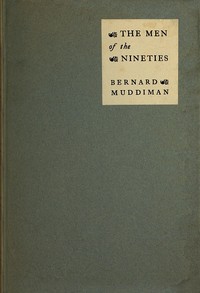
The Men of the Nineties — A Closer Reading
(0 User reviews)
1565
Project Gutenberg
2016
Not confirmed
English literature -- 19th century -- History and criticism; Art -- England
Readers of public-domain and historical texts
Project Gutenberg digital edition
en
Edition facts
Words
33,635
Reading time
147 min
Text sections
11
Before opening The Men of the Nineties — A Closer Reading, the edition data offers a quick orientation: 33,635 words, 2 hr 27 min estimated reading time, and 11 detected text sections.
The text analysis averages about 18.5 words per sentence, while the detected sections provide another way to judge how the source is divided.
Project Gutenberg metadata also associates the work with “English literature -- 19th century -- History and criticism,” connecting these edition facts with the source record’s subject description.
Source:
Project Gutenberg record #53142
Bernard Muddiman's 1921 study examines the literary and artistic circles of 1890s London, focusing on the Rhymers' Club, the influence of French symbolism, and the careers of poets like Ernest Dowson and John Davidson, using a conversational, period-specific voice.
Editorial Edition Score
4.7/5
★★★★★
★★★★★
Calculated from edition completeness, EPUB availability, text structure and catalogue metadata. Not a user rating.
How this score is calculated
- Description quality20 pts
- Title & short description10 pts
- Source metadata20 pts
- Text length15 pts
- Chapters / structure15 pts
- EPUB file integrity20 pts
Total of 100 points, scaled to a 2.5-5.0 range. Editions with an empty description or a missing EPUB file are not scored.
Edition quality
Read the Text
f many others. But when the nineties began Moore contrived to assist at their birth in the same way as he did later at that of the Celtic renaissance. Indeed, it is said, in Moore’s novel, _Mike Fletcher_ (1889), one can obtain a glimpse of the manner in which the period was to burgeon.
[1] See his _Literature at Nurse_, 1885.
There was, indeed, amongst the younger men in those early days a wonderful spirit of camaraderie. It was an attractive period full of the glamour of youth before it went down fighting for Art with a capital A, before age had chilled its blood or dulled its vision. And there came, no doubt, an immense vitality for them all, a stimulating energy to each one, from this meeting together in London. Indeed, coming together by chance, as it were, in London, they not only discovered one another and the ineffable boon of comradeship, but they also rediscovered, through Whistler, London for art. So once again the streets of London began to be written about, not it is true in the Dickens manner, but still with even as great a love as his. They went so far as to attempt to institute real French café life, by having meetings at the Cheshire Cheese and evenings in the Domino Room of the Café Royal. Symons wrote of the ballets of Leicester Square; Dowson of the purlieus round the docks; Davidson made poems of Fleet Street; Binyon sang of white St. Martin’s and the golden gallery of St. Paul’s; Crackanthorpe sketched his London vignettes; Street talks of the indefinable romance of Mayfair. In fact the nineties brought the Muses back to town. In a cabman’s shelter, in Soho restaurants of doubtful cheapness, in each other’s rooms, they rejoiced in each other’s company. At the same time Beardsley, by a stroke of luck through the good services of friends, was commissioned by Mr. Dent to illustrate _Le Morte d’Arthur_. The Bodley Press had begun in Vigo Street in 1887. Symons, Yeats, and others had already published their first books. The curtain had gone up on the drama of the nineties, of which this is intended as a brief appreciation.
At the date of the appearance of these young men amid a mass of lucubrators, there was actually a band of genuine young writers (besides the big Victorians like Meredith and Hardy), who were turning out good work, and who were under the sway of that old Pan of poetry, Henley of _The National Observer_. These young men of Henley must not be therefore confused with the _Yellow Book_ group. They were often deliberately coarse, not because they liked it, but because it was part of their artistic gospel. And when one considers the methods of the feeblest of them, one sees more ruffianly sturdy British horseplay than art, more braying and snarling than sounding on the lute. But among the best of them, Stevenson, Kipling, and Steevens, was a fine loyalty to the traditions of the leading spirit of the _Observer_ Henley--Pan playing on his reed with his crippled hoofs hiding amid the water-lilies of the purling stream. All these last writers and artists were men of the Anglo-Saxon tradition; while, on the other hand, the young men who had, so to speak, just come to town, were full of the Latin tradition. The main thing in the lives of these last was French literature and art, and out of this influence came not only the art, but the eccentricities, of the coterie, which is so often called the nineties. Theirs was a new spirit. They were of the order of the delectable ‘Les Jeunes.’ Epigram opened a new career with Oscar Wilde; Beardsley dreamed of a strange world; Ernest Dowson used to drink hashish and make love in Soho in the French manner of Henri Murger’s Latin Quarter--for a time, indeed, hair was worn long, and the ties of the petty homunculi of the Wilde crowd were of lace; but, fortunately, artists like Beardsley and the other men worth while did not cultivate foolishness except as a protection against the bourgeois.
Bernard Muddiman opens his 1921 study with a striking image: the day Aubrey Beardsley abandoned his insurance-office stool and ledger to illustrate Congreve. That moment, Muddiman suggests, marks the blossoming of a new English art movement. He immediately qualifies this, acknowledging that dividing literature into neat periods is 'uncommonly like damming up a portion of a stream to look at the fish in it.' The metaphor signals his awareness of the arbitrariness of periodization, even as he proceeds to chart the 1890s as a distinct 'secession from the art of the previous age.'
The Rhymers' Club and Its French Ties
Muddiman devotes considerable attention to the Rhymers' Club, a group without rules or officers that included W. B. Yeats, Ernest Dowson, Lionel Johnson, and Arthur Symons. He quotes Victor Plarr's account of a meeting where Oscar Wilde appeared, 'enthroned and surrounded by a differential circle.' The influence of French symbolists—Verlaine, Mallarmé, Baudelaire—was profound. Symons translated Baudelaire's prose poems; Dowson drew inspiration from Verlaine's Fêtes Galantes. Muddiman reproduces Plarr's wry observation that when a Frenchman visited, the group either fell silent or spoke 'a weird un-French French.' The passage captures both the earnest emulation and the self-conscious awkwardness of the Anglo-French literary exchange.
Silverpoints and the Early Period
Muddiman singles out John Gray's Silverpoints as a representative volume of the early nineties, though he does not analyze its contents in the excerpts. He contrasts this exotic, French-influenced strain with the 'staider traditions' upheld by poets like Francis Thompson and William Watson, who remained 'altogether unmoved' by Montmartre. The nineties group, he writes, 'only remained for a restive moment' before each member went his own way: Yeats to found the Irish School, Le Gallienne to America, Gray to the priesthood. Muddiman's phrasing—'all souls seeking the way to perfection in art'—suggests a romantic view of the period's creative ferment, but he also notes that many 'disappeared shortly afterwards from the lower slopes of Parnassus.'
From Mathews and Lane to Smithers
Muddiman traces a shift in the movement's publishing centers: from Elkin Mathews and John Lane in the early period to Leonard Smithers' Bond Street bookshop after Wilde's fall. He directs readers to the 'numerous slim plaquettes of verse' issued by these presses, promising 'golden verse worthy of the labour of his research.' The phrase 'odious necessity of a choice' acknowledges the difficulty of selecting from so many writers. He then announces his plan to treat Silverpoints as a typical early volume and to trace the careers of Ernest Dowson and John Davidson—two poets he deems 'certainly had the right to that appellation.' The excerpts end before these analyses begin, leaving the reader with a sense of a narrative cut short.
Muddiman's prose is conversational and occasionally self-deprecating, as when he admits that tracing all the clues to a movement's source is 'tedious.' Readers should expect a series of vivid vignettes rather than a systematic literary history. The book's value lies in its period details—the hansom cabs, the Fitzroy settlement rooms, the imported French poets—and in Muddiman's willingness to name the lesser-known figures who populated the 1890s literary scene. Approach it as a contemporary's sketch, not a definitive account.
Sometimes a book lingers less for its plot than for its quiet ache—the way Muddiman captures those poets losing themselves to twilight London. I felt that same tender melancholy flipping through the pages of Eben Holden's Last Day A-Fishing — Text and Context, where a single afternoon holds an entire lifetime's goodbye. Certain things just stay with you, soft and unhurried.
There are no reviews for this eBook.
There are no comments for this eBook.
Reader reflection
Record your reading impressions
A brief reflection can help important ideas stay with you longer.
Your progress
0
/
10
2
Was reading this book enjoyable?
3
Would you pass this book on to a friend?
4
Did the language feel accessible?
5
Which part made the strongest impression?
6
Did the book offer a fresh perspective?
7
Was the book easy to understand?
8
What did you think about the pace?
9
What did this book teach you most?
10